Decks
Slippery Deck Solutions: What Works and What Doesn't
By Noah Spagnotti

To make a deck less slippery, work in this order: clean off whatever is growing on it, fix the moisture that feeds it, add traction only where people walk, and have a pro look at the deck if the boards are soft or the problem keeps coming back. Skipping steps is why most quick fixes fail. A coat of grit paint over algae peels. Tape over damp wood lets go. And no amount of grip makes a rotting stair tread safe.
This guide walks through each step, what it takes in effort, and where a do-it-yourself fix stops making sense.
TL;DR
Most slippery decks are slick because of algae, mildew, moss or leaf film. Clean thoroughly, rinse, and let the deck dry completely first.
Cleaning restores the surface but does not make it permanently grippy. For lasting traction, add a compatible anti-slip coating, strips or treads on stairs and main walking paths.
Fix the cause: shade, sprinklers, downspouts that dump on the deck, and blocked gaps between boards keep the surface damp.
Never cover soft, spongy or cracked boards with an anti-slip product. Repair or replace them.
Old, damaged or persistently wet decks should be assessed by a contractor before you spend money on treatments.
First, work out why your deck is slippery
There are two different problems that feel identical underfoot, and they need different fixes.
Contamination. A thin film of algae, mildew, moss, pollen, or rotting leaves makes a wet deck slick. This is the common one on wood. The Decks.com guide to slippery decks points out that debris left on a deck keeps moisture in contact with the boards, which sets up the conditions for mold and mildew.
Inadequate traction. The surface is clean but smooth: worn sealer, a glossy paint, a smooth composite or plastic board, or a stair tread with no texture. Cleaning will not help here, because there is nothing to restore.
A quick test: scrub a small patch with a stiff brush and a cleaner, rinse it, let it dry, then wet it again. If it grips well, you had contamination. If it is still slick, you have a traction problem, and you should read the sections on coatings and materials below.
There is also a third question that has nothing to do with grip: is the deck sound? We cover that next, because it decides whether anything else is worth doing.
Check the structure before you treat the surface
Slipperiness and structural safety are separate checks. A deck can be perfectly clean and still dangerous if the boards, stair stringers, posts or connections have deteriorated.
The deck maintenance inspection guidelines from Montgomery County, Maryland's Department of Permitting Services suggest checking a deck at least once a year, using a screwdriver to probe the decking boards, joists, guardrail posts, handrails, stair stringers and treads. Wood that feels soft or spongy or flakes out should be replaced, and it should never simply be covered with an anti-slip product. The checklist singles out the spots where moisture lingers: wood-to-wood connections, support posts at grade level, and stair stringers at the ground and below the treads.
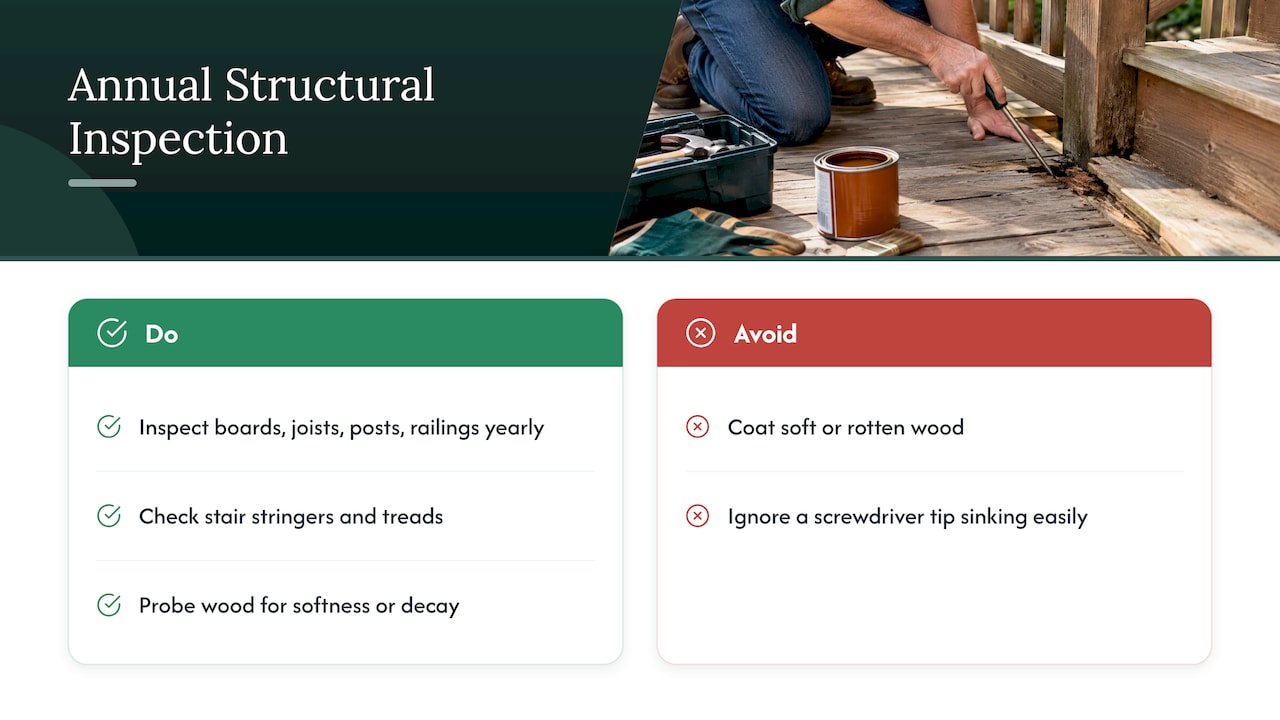
Walk your deck with a screwdriver and press the tip into the wood at those spots. If it sinks in easily, stop. You are past the point where a cleaner or a coating helps.
The U.S. Consumer Product Safety Commission recommends having a deck professionally inspected for structural soundness. Its outdoor repairs checklist estimates about 2,900 injuries and two deaths linked to deck, balcony and porch collapses or failures from 2016 through 2019. That figure covers collapses and failures, not ordinary slips, but it is a good reminder of what a damp, neglected deck can turn into.
If you find cracks, our guide to cracked deck boards explains what you can inspect yourself and when to call someone. A wobbly rail is a separate issue; see why tightening bolts is not enough.
Step 1: Clean the deck properly
For a deck made slick by algae, mildew, moss or leaves, cleaning is the first and often the biggest fix. The method in the Decks.com guide is straightforward:
Sweep off leaves and debris.
Apply a cleaner made for your deck material.
Let it sit for about 15 minutes.
Scrub with a stiff brush, working with the grain.
Rinse completely.
Let the deck dry before sealing, coating or taping anything.
A few practical notes from the field.
Pick the cleaner for the material. Wood, composite and PVC do not all respond well to the same product. Follow the label, and test a hidden corner first.
Be careful with pressure. Montgomery County's checklist notes that power washing done improperly can bring out the coarse grain of wood and increase the chance of splinters. A stiff brush and a lower-pressure rinse are safer for softwood.
Protect plants and runoff. Rinse the surrounding beds and keep cleaner away from storm drains. Read and follow the product label, particularly on moss and algae products. UC IPM treats algaecides as pesticides to be applied according to the label and kept out of waterways.
Do not rush the drying. This is where most failures begin. A coating or tape applied over algae, soap residue or damp wood can trap the problem or fail to bond. Give the deck a full dry day or more, depending on weather.
Cleaning should be an annual habit. Decks.com recommends a thorough cleaning each year, plus promptly sweeping leaves, particularly after storms and rain.
Step 2: Fix what keeps the deck wet
If you clean and the deck turns green again by next season, the cleaner is not the problem. Algae and moss grow in moist, shady spots, including decks, and the University of California's IPM program suggests redirecting downspout water away from hard surfaces and letting more light in to reduce the conditions they need. Treating growth without reducing the moisture usually brings it right back.
Here is what we check on a deck that will not stay dry:
Downspouts and sprinklers. Water from a roof or a lawn system landing on or beside the deck is one of the most common culprits. If your gutters discharge near the deck, see our guide to fixing downspout drainage. Gutters that overflow because they are clogged or undersized are a related cause, and our gutter installation and repair service covers that.
Gaps between boards. Debris packed into the gaps holds water against the board edges. Clear them with a putty knife or a thin gap tool. If the gaps are tight enough that water and debris sit in them, check your board manufacturer's spacing guidance before changing anything on an existing deck.
Shade and overhanging branches. Trimming back a tree or thinning a shrub can let sun reach the deck. That does more for algae than any product.
Ground contact and airflow. Leaves piling under the deck, stored items against the skirt, and planters sitting directly on boards all trap moisture.
One caution: do not drill, cut or re-space boards on a deck you suspect is structurally weak. That is a job for someone who can assess it first.
Step 3: Add traction where people actually walk
Once the deck is clean, dry and sound, you can add grip. The key is to target stairs, entrances, the path from the door to the grill, and any spot that stays wet, rather than covering the whole deck. These are the common options.
Option | Best for | Watch out for |
|---|---|---|
Anti-slip additive mixed into compatible paint or resin | Wood stairs and walking paths | Must be compatible with the finish; needs a clean, dry surface; wears over time |
Coarse-grit adhesive strips or tape | Stair treads, small high-risk spots | Edges can lift in freeze-thaw weather; need a clean, dry bond; can trap moisture underneath if poorly applied |
Outdoor rubber mats with secure backing | Entry points, temporary help | Can hold moisture and debris under them; shift if backing is poor |
Mechanically fastened treads (for example aluminum) | Stairs with heavy use | Fasteners must go into sound wood; cost more than tape |
Roll-on anti-slip coating | Smooth composite surfaces | Check that the product is compatible with your board type |
The Decks.com guide describes anti-slip products as using sand or aggregate to increase traction, and suggests a marine-grade anti-slip additive mixed into paint or resin for steps and high-traffic areas. Whatever you choose, follow the manufacturer's directions on preparation and cure time.
Two honest limits. First, rubber mats and tape are stopgaps. They help, but they do not fix the underlying surface. Second, on stairs, fastened treads tend to hold up better than adhesive products through Omaha's freeze-thaw winters, as long as they go into sound wood.
Paint, stain and sealer choices matter
A glossy film finish is slick when wet. If your deck is slick right after you refinished it, the finish itself may be the issue. Penetrating stains tend to leave the wood texture more open than a thick paint film, though results vary by product. We compare the two in paint vs stain for decks. If you are repainting a surface that was previously stained, our primer plan for painting over stained wood explains how to avoid stripping the whole thing.
Wintertime and wet-weather habits
Snow and ice are a different challenge from algae. Shovel promptly with a plastic shovel, which is gentler on boards and less likely to gouge a surface than a metal blade. Anti-slip mats or rubberized outdoor rugs made for wet conditions can add temporary traction in winter, but lift them periodically so the boards underneath can dry. Be cautious with rock salt, which can be hard on some finishes and metal fasteners. Check the product label for your decking material before using any deicer.
After heavy rain, sweep standing water and debris off the main paths. A five-minute sweep keeps leaves from becoming next month's slime.
When the right fix is replacing boards or the material
Sometimes repeated cleaning and recoating is a losing battle. Replacement, or a partial rebuild, is the better answer when:
boards are soft, cracked, splintered or rotten;
stair treads or stringers are deteriorating;
the deck is in deep shade or stays wet no matter what you change;
the surface is smooth by design and no coating bonds reliably;
the deck is old enough that you are patching it every season.
Material choice matters too. In its testing, Consumer Reports found that wood resisted slips best in both wet and dry conditions, followed by aluminum, while some composite and plastic products performed less well. That is a test finding, not a ranking of every board on the market, so ask for wet-condition slip data on the exact product you are considering.
If you are planning a new deck or a major board replacement, our post on what a contractor should check before building or replacing a deck lists the items that affect drainage, framing and long-term safety.
Our perspective: treat slipperiness as a symptom
We do not start a slippery-deck call by recommending a product. We start by asking why the deck is wet and whether it is sound.
A slippery deck is a good example of why planning comes first. When homeowners call us, the stated problem is "it is slick." The actual problem is often one of three things: a downspout aimed at the deck, a stair stringer that has been wet for years, or a finish applied over a surface that was never cleaned. Selling a grip coating in any of those cases would take the homeowner's money and leave the cause in place.
So our advice is this. Clean it and see how it behaves. If it is clean and still slick, add traction where you walk. If it is soft, discolored at the stair bottoms, or wobbly anywhere, stop treating the surface and have it assessed. A treated, slippery deck with failing structure is worse than an untreated one, because it looks safe.
We would rather tell you a ten-dollar fix is enough than sell you a rebuild you do not need. And when a rebuild is the honest answer, we will explain what needs replacing and why before work begins.
Deck repair and rebuilds in Omaha
If your deck needs more than a scrub, our deck building and repair service covers both repair and new construction across the Omaha metro, and we are licensed and insured. New deck construction is listed at $35–50 per sq. ft. for pressure-treated wood and $50–70 per sq. ft. for composite, depending on the design and materials. Deck repairs start at $795, and structural repairs start at $1,495; the final price depends on what we find, since the scope varies so much between a few boards and a stair rebuild. Start with a personalized estimate and we will tell you plainly whether you need a repair, a partial replacement or just a good cleaning.
A simple seasonal routine
This takes less time than a Saturday football game and prevents most slick-deck calls.
Spring: Inspect boards, stairs, posts and rails. Clean, rinse and let dry. Re-apply finish only if needed.
Summer: Move planters and mats now and then so boards underneath can dry. Check that sprinklers are not soaking the deck.
Fall: Sweep leaves frequently. Clear gaps. Make sure gutters and downspouts are flowing away from the deck.
Winter: Clear snow promptly and check traction at stairs and entrances.
FAQ
What is the best solution for a slippery deck?
For most wood decks, a thorough cleaning followed by drainage fixes solves the problem. If the surface is still slick when wet after cleaning, add traction to stairs and walking paths with an anti-slip additive, grit strips or fastened treads. If the boards are soft or damaged, repair or replace them first.
What can I put on a deck to make it not slippery?
Options include an anti-slip additive mixed into compatible paint or resin, coarse-grit adhesive strips, outdoor rubber mats with secure backing, and mechanically fastened treads. Apply them to a clean, dry, sound surface. Make sure any product is compatible with your decking material and current finish.
How do I make a deck less slippery when it is wet?
Keep water from lingering. Sweep debris, clear the gaps between boards, redirect downspouts and sprinklers, and cut back shade where you can. Then add traction at stairs and entrances. A wet deck that is also soft or spongy needs repair, not just grip.
Can I put anti-slip coating over algae or mildew?
No. Coatings and tape applied over algae, soap residue or damp wood can trap the problem or fail to bond. Clean, rinse thoroughly and let the deck dry completely before applying anything.
When should I call a contractor about a slippery deck?
Call when the deck is old, shows soft or rotting wood, stays wet despite your efforts, has wobbly rails or stairs, or you are unsure it is safe to walk on. A contractor can assess structure and recommend repair, partial rebuild or replacement before you spend money on surface treatments.
Sources
Deck Maintenance Inspection Guidelines, Montgomery County (MD) Department of Permitting Services
Outdoor repairs checklist, U.S. Consumer Product Safety Commission
Recommended
Dealing With Something Similar?
Every property is different, but if this sounds like what you’re seeing, we’re happy to take a look and help you figure out what’s actually going on.