Roofing
15 Minute Hail Check for Homeowners to Protect Your Insurance Claim
By Noah Spagnotti

Yes, hail leaves visible signatures on roofs and the metal surfaces around your property, and three signs matter most: circular granule-loss spots on shingles, dented gutters or AC fins, and granules collecting in your downspouts. If you spot any of these, photograph everything, stay off a wet or steep roof, and call a professional for a documented inspection. Waiting costs you both roof life and leverage with your insurer.
TL;DR:
Hail can cause functional damage to shingles through mat fractures that are often invisible without professional inspection.
Denting marks on metal, cracking tiles, or splintered wood are key visual clues for impact on other roof types, confirmed by ground-level evidence.
Impact density, not hail size alone, determines whether damage is cosmetic or requires full roof replacement, especially once impact fractures occur.
Professional on-roof inspections include detailed impact counts and written reports, which are crucial for accurate insurance claim valuation.
Documenting damage immediately after a storm with photos and professional reports significantly improves the likelihood of a favorable insurance settlement.
Table of Contents
Signs of Hail Damage on Asphalt and Composition Shingles
Signs on Metal, Tile, and Wood Roofs
Ground-Level Evidence You Can Check Safely After a Storm
Why a Professional On-Roof Inspection Still Matters
What Hail Size Actually Causes Real Damage
Documenting Hail Damage for Your Insurance Claim
Will Your Roof Need Repair or Full Replacement?
What a Local Contractor Actually Looks for During a Hail Inspection
Get a Documented Hail Inspection From Spagnotti Contracting
Sources
Signs of Hail Damage on Asphalt and Composition Shingles
Asphalt shingles show hail damage in two distinct ways, and homeowners often only recognize one of them. The first is granule loss: circular spots of varying small sizes, where hail knocked the protective granules off the shingle surface. These spots look darker than the surrounding shingle because you’re seeing the black asphalt mat underneath instead of the mineral granules that shield it from UV rays. The pattern matters too. Hail hits are random and scattered across a slope, unlike the streaky, linear wear you get from foot traffic or a scraping tree branch.
The second sign is bruising, and it’s the one most homeowners miss entirely. A bruise is a soft spot where the impact fractured the fiberglass mat beneath the granules without necessarily knocking granules loose. You can’t always see a bruise. You often have to feel for it, and even then, Travelers’ hail identification guidance warns that normal wear and tear gets confused with hail strikes constantly, which is exactly why a trained eye matters more than a quick glance from the driveway.
Here’s the part that catches people off guard: a bruised shingle can look almost fine from 20 feet up. The real damage is structural, not cosmetic, and it shortens the shingle’s service life even without a leak showing up this year. A fractured mat lets water in eventually. It just takes time.
If you want to check safely without climbing anything, here’s what you can look at from the ground or from a stable ladder against a low eave:
Scan for randomly scattered dark spots across a single slope, not just near edges.
Look for granules missing in small circular clusters rather than long scrape marks.
Check if the exposed area looks shinier or darker than the surrounding shingle.
Note whether damage clusters on the roof faces that took the brunt of the storm’s wind direction.
Pro Tip: Grab a handful of granules from your gutter after a hailstorm. If you find a noticeable pile that wasn’t there before, that alone is often enough reason to schedule an inspection, even if the shingles look untouched from below.
Signs on Metal, Tile, and Wood Roofs
Not every roof shows hail damage the way shingles do, and that trips up a lot of homeowners who only know the asphalt playbook.
Metal roofing dents. That’s the giveaway. Hail leaves small, shallow depressions, sometimes cosmetic, sometimes deep enough to compromise the coating. Once the protective paint or coating cracks at the dent site, moisture can work its way into the panel seams over time. Check fastener heads and seams closely, since impacts near a seam are more likely to eventually leak than a dent in the flat panel field.
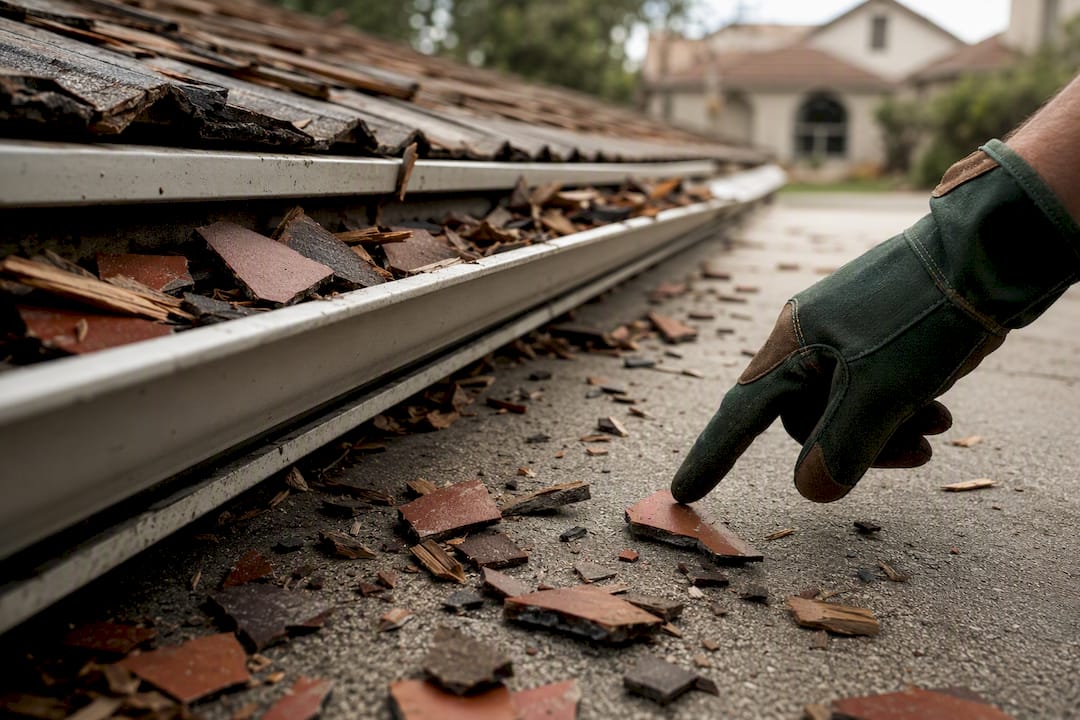
Tile and slate roofs react differently again. Instead of dents or granule loss, hail cracks or shatters individual tiles. The damage is usually isolated rather than widespread. A single cracked tile might seem minor, but it creates a direct path for water underneath the roofing system, and slate in particular can shatter into sharp fragments that fall and pose a hazard below.
Wood shingles and shakes are the most fragile of the group when they’ve dried out and aged. Hail causes splitting along the wood grain, often with sharp, jagged edges rather than the round pattern you’d see on asphalt. Older, more brittle wood roofing cracks more readily than newer material, so age matters as much as hail size here.
Ground-level clues help confirm what’s happening up top on any of these roof types. If you find broken tile fragments or splintered wood shakes in your yard or gutters after a storm, that’s direct physical evidence the roof took hits, even before anyone climbs up to look. Pair that with what you already know about your specific roofing material, and you’ve got a solid case for calling in a professional before small isolated damage turns into a bigger leak.
If you’re weighing whether your current shingle type held up as well as it should have, it’s worth reading about how different shingle types perform against impact and weather over time.
Ground-Level Evidence You Can Check Safely After a Storm
You don’t need to climb a ladder to find strong evidence of hail damage. Some of the most reliable indicators sit right at eye level, and checking them takes fifteen minutes.
Work through these in order right after a storm passes:
Check your gutters and downspouts. Granule buildup here is one of the clearest signs a storm shed material off your shingles, and dents in the gutter troughs themselves confirm impact force.
Inspect your HVAC condenser unit. The thin aluminum fins on an outdoor AC unit dent easily, and dented fins are considered strong, verifiable evidence that adjusters can confirm independently of anything happening on the roof.
Look at garage doors, mailboxes, and any exposed metal trim. Soft metal surfaces mark up quickly and give you a rough sense of hail size and impact force.
Check window screens and vinyl siding. Punctures in screens or small pitted marks on siding panels tell you the storm had real force behind it.
Compare notes with neighbors. If three houses on your block have dented gutters and cracked screens, that pattern makes an isolated claim look a lot more credible to an adjuster.
None of this requires you to risk a fall. Collateral evidence like this is often the strongest ground-level proof a property took a hit, especially on roofs where shingle damage is genuinely hard to spot without training. Vehicle damage counts here too. If a car parked in the driveway during the storm picked up dents, that’s a dated, easy-to-photograph reference point for exactly when the impacts happened.
Why a Professional On-Roof Inspection Still Matters
Ground checks get you evidence, but they don’t get you the full picture. Most functional hail damage is genuinely invisible from the ground, and that’s not a sales line, it’s just physics: a fractured shingle mat rarely shows enough contrast to spot from your yard, even with good binoculars.
That’s why contractors and adjusters rely on a different process entirely. A trained inspector walks the roof (or flies a drone over it) and marks off test squares on each slope, then counts strikes within that marked area. Industry practice typically treats a moderate number of impacts per test square as a common threshold adjusters look for when assessing whether a slope has sustained functional damage. Chalk marks circle each confirmed strike to ensure accurate counting when the report is written up.
Here’s what a real inspection report should include:
Slope-by-slope test-square counts with chalk-marked strikes
High-resolution, dated photos tied to the storm date in question
A written summary distinguishing cosmetic marks from functional mat damage
A clear recommendation: repair, partial replacement, or full replacement
Pro Tip: Never climb onto your own roof after a storm to check for damage yourself. Wet shingles, granule loss, and steep pitches make for a genuinely dangerous combination, and one bad step turns a hail claim into a much bigger problem.
Because InterNACHI’s inspection guidance points out, there’s no single uniform industry standard for what counts as “minor” hail damage. That gap is exactly why a documented professional opinion carries more weight than a homeowner’s photos alone, even when those photos are good.
What Hail Size Actually Causes Real Damage
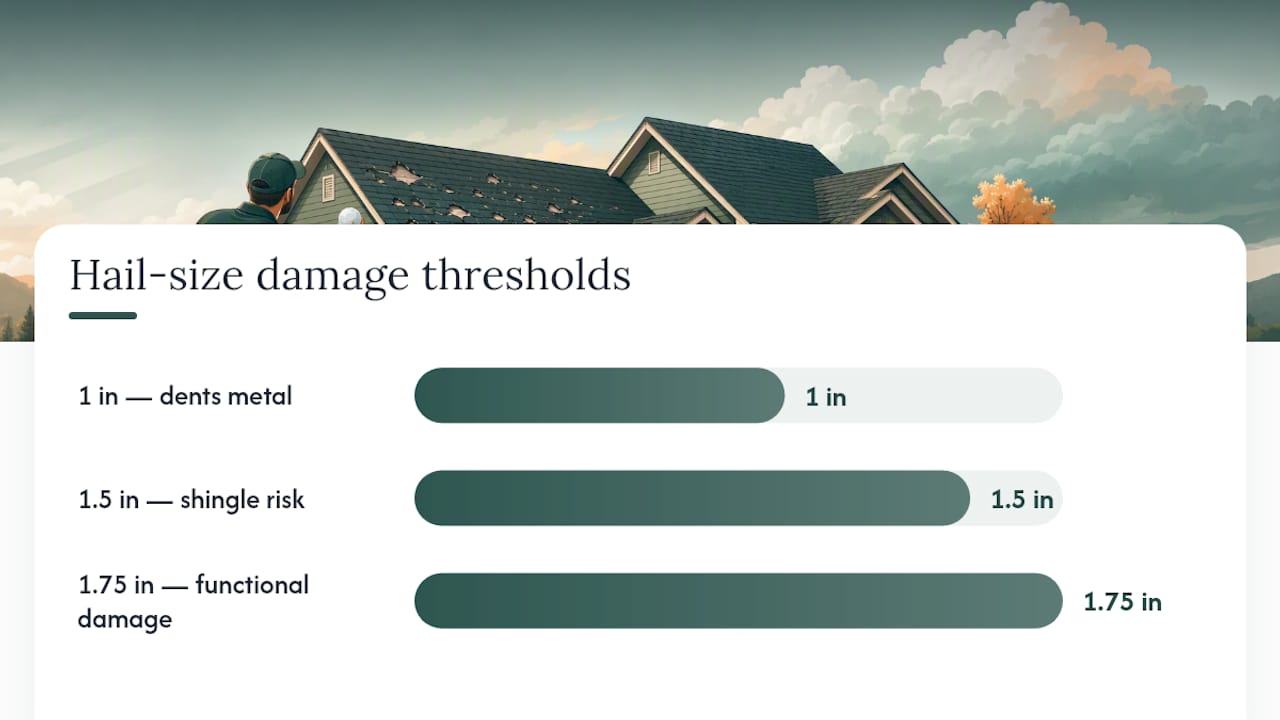
Bigger hail does more damage, but the size threshold that matters is smaller than most people assume. Hail around 1 inch in diameter, roughly the size of a quarter, can already dent soft metals like gutters and AC fins and cause the collateral damage discussed earlier. Once hail reaches somewhere in the 1.5 to 1.75 inch range, functional asphalt shingle damage becomes far more likely, meaning actual mat fracturing rather than just surface scuffing.
Impact-resistance ratings play into this too. Roofs rated Class 4 under standard testing hold up better against smaller hail than a Class 3 or unrated roof, but even a Class 4 roof shows evidence once hail gets large enough and falls with enough velocity.
The distinction that actually matters for your claim isn’t hail size on its own. It’s whether the damage is cosmetic or functional:
Cosmetic damage scuffs the surface without breaking through to the fiberglass mat. It doesn’t shorten roof life in any measurable way.
Functional damage fractures the mat, exposes it to moisture, and cuts years off the shingle’s expected lifespan even without an active leak.
Adjusters and experienced contractors don’t make this call based on one or two scuffs they happen to notice. They look at impact density across the whole slope and whether the mat itself is compromised, because a couple of surface marks on an otherwise sound roof isn’t the same claim as a slope riddled with fractured shingles.
Documenting Hail Damage for Your Insurance Claim
Good documentation is what separates a smooth claim from a drawn-out argument with your insurer. Start building your file the same day the storm passes, while everything is still fresh and dated.
Photograph these areas first:
Gutters and downspouts, with close-ups of any granule piles
HVAC condenser fins and any dents visible on the unit
Vehicles parked outside during the storm
Wide shots of each roof slope, followed by close-ups of individual shingle spots
Window screens, siding, and any exterior trim that shows pitting or punctures
Frame wide shots to capture context (the whole slope or the whole vehicle) and then follow with tight close-ups on the damage itself. Time-stamp everything if your camera allows it, and note the storm date in your own records even if the photo metadata already captures it.
When your contractor arrives, ask them to produce:
Slope-by-slope test-square counts with visible chalk marks
High-resolution, dated on-roof photos for every affected area
A written report that cites the specific storm date and ties damage to that event
A clear scope of repair or replacement based on what they found
Contractor-grade documentation like this carries far more weight with adjusters than casual homeowner photos alone, since it gives them chalk-marked counts and a written professional opinion instead of a handful of snapshots. A post-storm inspection checklist can help you organize this process before the contractor even shows up. Keep everything in one folder named by storm date, and if neighbors also sustained damage, a quick note from them corroborating the event date only strengthens your file.
Will Your Roof Need Repair or Full Replacement?
The honest answer is that it depends on impact density, not just whether damage exists at all. Insurers weigh a few specific factors when deciding how to settle a hail claim: how many confirmed strikes appear per test square, whether the mat itself is fractured across multiple slopes, how much life the roof had left before the storm, and whether your policy pays actual cash value or replacement cost value.
Isolated damage, a handful of dented tiles or a small cluster of bruised shingles on one slope, usually gets a repair recommendation. Widespread mat fracturing across most or all slopes typically pushes contractors toward recommending full replacement, since patching a roof with scattered functional damage rarely restores its original service life.
Your best move after an inspection is straightforward:
Get the documented inspection completed and in writing before you file
Submit your claim with that documentation attached, not just your own photos
Have your contractor present during the adjuster’s on-site inspection, if your insurer allows it, so the scope discussion happens with someone who already walked your specific roof
If your contractor’s report leans toward replacement rather than a patch job, it helps to understand how that repair-versus-replacement decision typically gets made before you’re sitting across from an adjuster trying to make sense of unfamiliar terms.
What a Local Contractor Actually Looks for During a Hail Inspection
Most homeowners assume a hail inspection means someone glances at the roof from a ladder and hands over an estimate. That’s not what a useful inspection looks like, and it’s not what protects you if your claim gets questioned later.
A proper inspection means walking every slope, not just the one visible from the street, and marking test squares on each one to get an honest strike count rather than a guess based on the two or three spots that happen to be easy to see. It means photographing every finding at close range with a timestamp, not just snapping a couple of wide shots for a file. And it means writing an actual report that ties what we found to the storm date in question, because an adjuster reading a vague summary has no reason to trust it over their own quick look.
The other piece homeowners underestimate is communication. A report full of technical language means nothing if nobody explains it to you in plain terms before your insurer meeting happens. Good contractors walk you through exactly what the findings mean, what to expect from the claim process, and what questions to ask if the adjuster’s assessment doesn’t match what was documented on your roof. Scheduling one is simple: a quick call sets up an on-site visit, and you get a written report before any decisions get made.
— Noah
Get a Documented Hail Inspection From Spagnotti Contracting
If your roof took a hit, guessing isn’t a strategy. Spagnotti Contracting handles the on-roof legwork yourself would rather not risk. That means slope-by-slope test squares, chalk-marked strike counts, and a written report with dated photos ready to hand to your insurer, at no cost to you for the inspection itself.

Beyond roofing, the team also manages siding, gutters, and full exterior repairs, so if hail damaged more than just your shingles, one contractor coordinates the whole scope instead of juggling separate crews. Our roofing team can walk your property, document what’s there, and give you a straight answer on repair versus replacement before you ever file a claim. If you’re ready to get your roof looked at, request an inspection through our roofing services page and we’ll schedule a visit that fits your timeline.
Sources
For homeowners who want to dig deeper into hail damage identification and inspection standards, these resources cover the material this article draws from:
Recommended
Dealing With Something Similar?
Every property is different, but if this sounds like what you’re seeing, we’re happy to take a look and help you figure out what’s actually going on.