General Contracting
Exterior Paint Temperature: What Range Works and When to Wait
By Noah Spagnotti
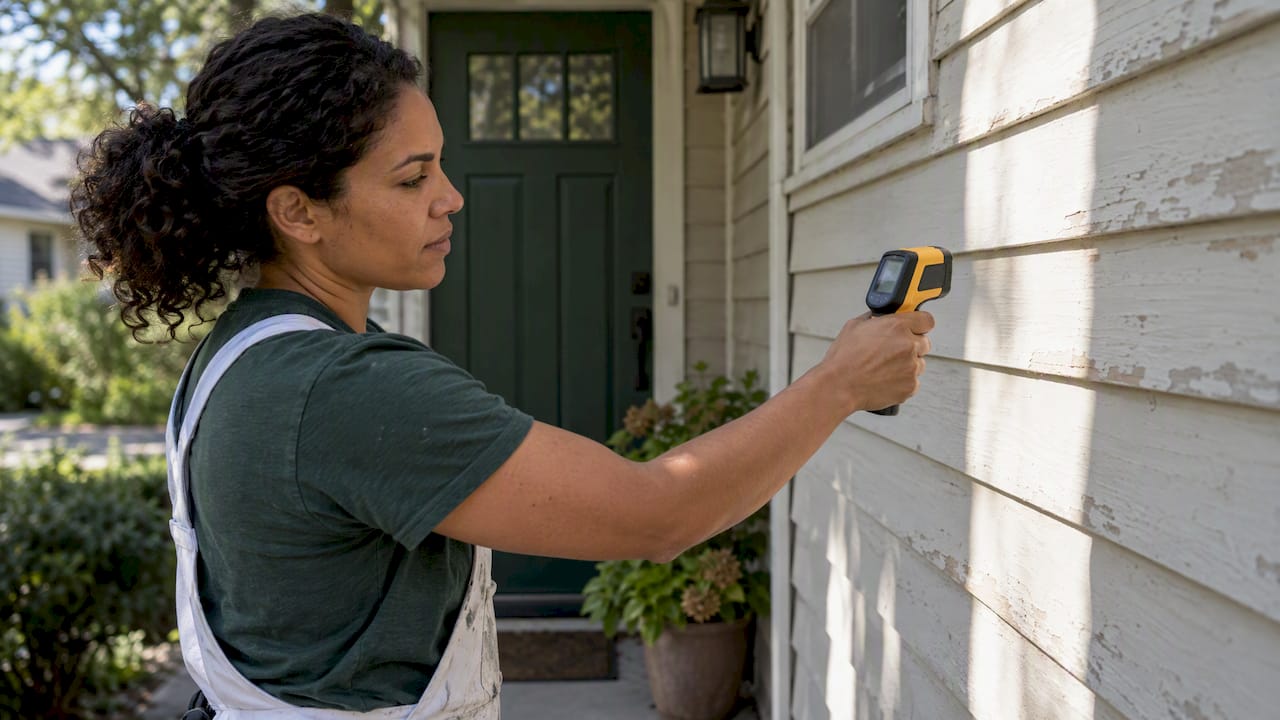
Most standard exterior latex paint is meant to go on at 50°F or warmer, and the temperature needs to hold above that floor while the paint cures, including overnight. Some cold-weather formulas are labeled for air temperatures as low as about 35°F. The label on your specific product always wins, and the overnight low matters as much as the afternoon high.
This guide covers the common ranges, why surface temperature and dew matter more than the weather app, how to paint in cold weather without ruining the finish, and how to read an Omaha forecast before you commit a crew or a weekend.
TL;DR
Standard exterior latex: apply at 50°F or warmer. The USDA Forest Products Laboratory says the temperature must stay above 50°F for 24 hours for latex paint and above 40°F for oil paint (USDA Forest Service).
Some cold-weather formulas can go on as low as about 35°F, but the air and surface still need to stay above the product's minimum for the first 48 hours, even in the evenings (Family Handyman).
Never paint a damp surface, and stop early enough that the paint can set before evening dew forms.
In Omaha, the reliable windows are late spring and early fall. Late October and November are a gamble.
The short answer: temperature ranges by paint type
There is no single number, because paint chemistry varies. The ranges below come from independent guidance; the label on your product is the final word.
Situation | Typical limit | Source |
|---|---|---|
Standard exterior latex | Above 50°F, holding above 50°F for 24 hours | |
Oil-based house paint | Above 40°F, holding above 40°F for 24 hours | |
Most exterior paints | Applied between 50°F and 90°F | |
Cold-weather formulas | Some are made for air temperatures as low as 35°F | |
Nights after painting | Not below 32°F for several days |
Read that table as a reminder that the can and the product's data sheet are the authority. Consumer Reports gives the same advice: check the label on the paint can for the ideal temperature range (Consumer Reports).
Why the ranges differ
Latex paint dries in two steps. Water leaves the film, then the resin particles fuse together into a continuous coat, and that step needs warmth. Below a product's minimum, the film may not form properly. Cold-weather paints are formulated to form a film at lower temperatures, but the USDA Forest Products Laboratory notes that choosing one can mean a tradeoff, such as shorter life or higher cost, so it is better to work in warm weather when you can (USDA Forest Service).
Minimum temperature for painting an exterior
If you are asking how cold is too cold, work through it in this order.
Check the product. If it is a standard latex, 50°F is the floor. If it is labeled for cold weather, confirm its minimum on the label or data sheet rather than assuming one.
Check the after-hours forecast. The temperature needs to hold after you put the brush down. Family Handyman calls the first 48 hours of drying and curing critical: air and surface temperatures need to stay above the paint's minimums, even in the evenings (Family Handyman).
Check the freeze line. Consumer Reports says the temperature shouldn't drop below 32°F at night for several days after painting, because even if it's warm during the day, the paint won't form a good film if nights get too cold (Consumer Reports).
A 55°F afternoon followed by a 30°F night is the classic trap. The wall reads fine at 2 p.m., but the paint does not get the warm hours it needs to form a good film.
Air temperature is not surface temperature
The number on your phone is air temperature in the shade, usually measured a few feet off the ground. Your siding can be noticeably warmer or colder.
A south or west wall in afternoon sun can run far hotter than the air. A north wall in early spring can sit colder than the air for hours after sunrise, and after a stretch of cold days the material you are painting may be colder than the air (Family Handyman). An infrared thermometer reads the wall itself instead of the air.
No thermometer? Consumer Reports suggests a palm test: if you can't keep your palm on the exterior wall for more than a few seconds, it's too hot to paint (Consumer Reports).
Why direct sun causes trouble
Family Handyman advises avoiding direct sun: even when the air is cool enough for paint to dry evenly, the sunlit surface probably isn't, and you risk cracking, blistering and other defects (Family Handyman). The USDA Forest Products Laboratory adds that you should not paint a cool surface that will be heated by the sun within a few hours (USDA Forest Service). In practice that means following the shade around the house: east side in the morning, south and west in the evening, north whenever the day is mild.
Dew point and humidity
Temperature gets the attention, but moisture ruins plenty of fall paint jobs. The USDA Forest Products Laboratory warns against painting at the end of a cool day when heavy dew will form at night (USDA Forest Service). Consumer Reports explains that as the temperature dips, dew can form on surfaces and cause the water in the paint to evaporate too slowly, which affects how well the paint holds up, including how well it resists cracking. Colder temperatures and moisture on the surface can also cause staining or mildew (Consumer Reports).
Here is why that matters. When the surface cools to the dew point, dew forms. If that happens before the paint has set, condensation can run down the wet film, carrying paint away and leaving streaks (Family Handyman).
A simple routine:
Look up the forecast dew point for your ZIP code, not just humidity.
Start after the morning dew has burned off. Walk the wall and touch it.
Stop early enough in the afternoon that the paint has time to firm up before the evening temperature drops toward the dew point.
If the overnight low is forecast to reach the dew point, expect dew on the wall and treat that coat as at risk.
Will exterior paint dry at 50 degrees? And at 90?
At 50°F, standard latex will generally dry, but slowly. It sits at the very bottom of the usual range, which means you have no margin if the night turns cold or damp. Expect longer recoat times than the can's headline numbers, which are written for mild conditions; Family Handyman suggests planning at least 24 hours between coats in cold weather (Family Handyman). Choose a day that climbs well above 50°F and starts early.
At 90°F, paint dries fast, sometimes too fast. Family Handyman warns that above 90°F paint can dry too quickly, leading to poor adhesion, visible brush strokes and roller marks (Family Handyman). Humidity matters too: high humidity slows drying, very low humidity speeds evaporation, and the same guide recommends moderate humidity between 40 and 70 percent. On a hot day, work in shade, start early and keep a wet edge.
The sweet spot is the middle. Family Handyman puts the best exterior painting temperatures between 50°F and 85°F, roughly the range where you can work outside comfortably without a coat or breaking a sweat (Family Handyman).
Painting in cold weather: can you, and how?
Sometimes, with the right product and a good forecast. Family Handyman notes that some manufacturers make cold-weather paint that can be used at air temperatures as low as 35°F, but even with those, success isn't guaranteed (Family Handyman).
A cold-weather checklist
Pick a cold-weather paint. Confirm its minimum on the label or data sheet. Do not assume a gallon is rated for 35°F because it is a premium brand.
Keep the paint warm. Paint stored in an unheated garage is as cold as the garage. Bring it inside overnight so it can warm up, and keep it warm while you work (Family Handyman).
Don't let it freeze. Follow the storage range on the label. If paint has been through a hard freeze, check with the manufacturer before using it.
Wait for a dry surface. Frost, dew and damp wood all work against adhesion.
Paint in the warmest part of the day. Late morning through mid-afternoon is typical, then let the wall settle before sunset (Family Handyman).
Plan for the following two days. Look at the overnight lows for 48 hours, not only the day of the work.
What not to do
Do not thin paint to stretch it, do not add heaters pointed at the wall, and do not push a coat onto a wall that is still wet from last night. None of those fixes the chemistry problem; they usually add a second one.
Rain, wind and the cure window
Temperature is half the story. The Spruce recommends choosing a 24 to 48 hour period without rain or high winds, and it quotes a painting pro who recommends waiting at least 24 hours after rain before starting (The Spruce).
A surface can feel dry and still be soft underneath, which is why the early hours and the first nights decide how well the coat sets. Wind adds one more wrinkle, since it speeds surface drying and blows debris into wet paint.
Timing a paint job in Omaha
Omaha has a continental climate, with very cold winters and hot summers. Climate data based on 1991 to 2020 averages show about 134 days a year with minimums at or below freezing, usually from October through April (Climates to Travel). The same source puts the average October low near 43°F (6.2°C) and the average November low just below freezing, at about 30°F (-1°C).
What that means for a Nebraska homeowner:
Late spring through early summer is the strongest window. The Spruce calls late spring and early fall ideal, since temperatures are moderate and humidity and rain are comparatively low (The Spruce).
Midsummer works if you follow the shade and start early. Afternoon sun on a west wall can be too hot to paint.
September to mid-October is good, with the dew caveat above. Cold mornings are the problem, so start late.
Late October into November is the edge. A day may reach the 50s, but nights near or below freezing are normal. Only a cold-weather product and a stable forecast make sense.
December through March is generally not the time for full exterior repaints. Interior work is the better use of those months.
If you are reading this in late fall and your house is not primed yet, the honest answer is often to schedule it for spring and use the time to settle color, scope and prep. Rotted trim and damaged boards can often be repaired in cold weather even when painting cannot happen.
Prep and sequence matter as much as the weather
Good weather will not save a poorly prepared wall. Before any coat goes on:
Wash the surface and let it dry fully.
Scrape, sand and spot-prime bare wood.
Replace damaged boards and renew failed caulk.
Match primer and paint to the surface and the season.
If you are deciding between paint and a stain finish, our guide on paint versus stain for exteriors lays out how each behaves. If the wood is already stained, see painting over stained wood for the primer plan. When quotes come back far apart, why painting estimates vary so much explains what to compare.
Our perspective
Exterior painting is easier to schedule around the forecast than around the calendar. Before a coat goes on in late October, three questions are worth asking: what is the overnight low for the next two days, what is the dew point, and what does the paint's label say?
Moving a start date costs less than putting a coat on a wall that will not cure. Sequence matters too. If trim is rotten or siding needs attention, that work belongs before the paint, because paint over a failing surface does not last.
The best exterior paint job is the one done at the right time with the right product. A short wait in Nebraska is cheap compared with repainting a house that peeled early.
Planning your exterior paint project with us
Spagnotti Contracting handles interior and exterior painting across the Omaha metro area. Our painting services page lists exterior starting prices: $5,500–$8,000 for a smaller exterior painting project, $8,000–$13,000 for a medium home exterior and $15,000 and up for a large or complex exterior, with a $3,500 minimum for a standalone exterior painting project. Final pricing depends on home size, height, siding material, coating condition, preparation, access and the number of colors.
Painting often pairs with other exterior work. If your siding, gutters or roof need attention first, that work should come before the paint. Browse all our residential services or contact us about your timeline.
FAQ
What is the minimum temperature for painting an exterior?
For standard latex, it is 50°F, and the USDA Forest Products Laboratory says the temperature should stay above 50°F for 24 hours (USDA Forest Service). Some cold-weather paints are made for air temperatures as low as 35°F (Family Handyman). Your product's label sets the exact figure.
Can you paint a house exterior in winter?
Sometimes, but it is rarely the best choice in Nebraska. It requires a cold-weather paint, a dry surface, and air and surface temperatures above the product minimum for the first 48 hours, even in the evenings (Family Handyman). Consumer Reports adds that nights shouldn't drop below 32°F for several days after painting (Consumer Reports). Many Omaha winter stretches fail that test.
What is the best temperature to paint a house?
The middle of the range is the safest: mild days, moderate humidity, no rain for 24 to 48 hours and a night that stays well above the paint's minimum. Family Handyman puts the best range at 50°F to 85°F (Family Handyman), and late spring and early fall are the seasons most guides recommend (The Spruce).
Is it too hot to paint at 90°F?
90°F is the upper end of the usual range for most exterior paints (Family Handyman). Consumer Reports says the wall matters more than a set air number: if you can't keep your palm on the wall for more than a few seconds, it's too hot to paint (Consumer Reports).
How should I store paint in cold weather?
Keep it where it won't freeze and follow the storage range on the label. If it sat in an unheated garage, bring it inside overnight to warm up before use; Family Handyman recommends keeping paint warm when painting in cold weather (Family Handyman).
Sources
Outdoor Temperature Range for Exterior Paint, Consumer Reports
DIY Guide to Painting a House During Winter, Family Handyman
When Is the Best Time to Paint the Exterior of a House?, The Spruce
Recommended
Dealing With Something Similar?
Every property is different, but if this sounds like what you’re seeing, we’re happy to take a look and help you figure out what’s actually going on.