General Contracting
DIY Homeowners: 6 Step Paint Finishes Explained by Pro With PVC Tips
By Noah Spagnotti

Paint sheen is simply how much light a dried paint film reflects, ranging from flat (no shine) to high-gloss (mirror-like). For most DIY projects, that spectrum breaks down into a manageable order: flat and matte for low-traffic surfaces, eggshell and satin for everyday walls, and semi-gloss or high-gloss for trim and cabinets. Use the checklist below and always test a sample patch before committing to a full room.
TL;DR:
Choosing the right sheen depends on traffic and moisture levels, with satin and semi-gloss preferred for high-use and damp areas.
Flat and matte finishes are best for ceilings and textured walls, as they hide imperfections and scatter light evenly.
Sample testing in natural room lighting before painting prevents unwanted sheen surprises on walls of different colors.
Surfaces with uneven textures or patches look worse in higher sheen paints, making flat or matte finishes better for damaged walls.
Proper prep, including priming and applying thin, even coats, is more critical to achieve a smooth, professional appearance than shear choice alone.
Spagnotti Contracting
Plan Your Interior Remodel With Confidence
Spagnotti Contracting provides detailed planning, clear communication, and project management for residential interior remodeling in the Omaha metro area.
Table of Contents
Types of Paint Finishes: The Sheen Spectrum Explained
How Sheen Changes the Way Color Looks on Your Walls
Durability, Cleanability, and the Best Sheen for Every Room
Your Paint Sheen Decision Checklist and Cheat Sheet
Prep and Application Tips That Determine Your Final Sheen
How Spagnotti Contracting Handles Finish Selection on Real Projects
Oil-Based vs. Water-Based Paint: What Changes With Sheen
How Surface Texture Changes the Way Sheen Looks
Common Myths About Paint Sheen You Should Ignore
VOC Levels and Environmental Factors Across Paint Sheens
Why the “Just Pick a Popular Sheen” Advice Falls Short
Sources
Types of Paint Finishes: The Sheen Spectrum Explained
Paint brands don’t always agree on names, but the core lineup stays consistent across the industry. Benjamin Moore lists seven common interior options: Flat, Matte, Eggshell, Pearl, Satin, Semi-Gloss, and High Gloss. Here’s what each one actually does:
Flat/Matte — Almost no shine, absorbs light rather than bouncing it. Best for ceilings, adult bedrooms, and any wall with dents, patches, or texture you’d rather not advertise.
Eggshell — A soft, low luster somewhere between flat and satin. Works well in living rooms, dining rooms, and hallways that see moderate use.
Satin — A smooth, velvety sheen with noticeably more reflection than eggshell. This is the workhorse finish for kitchens, family rooms, and kids’ bedrooms.
Semi-Gloss — Shiny and durable, easy to wipe down. The standard pick for trim, doors, and cabinets, and a common choice for bathroom walls.
High-Gloss — The most reflective and hardest-wearing finish, but it shows every roller mark and surface flaw. Usually reserved for furniture, cabinetry, and accent doors rather than whole walls.
You’ll also see “pearl” or “low-lustre” on some cans. These aren’t separate categories so much as marketing labels that sit between the standard tiers. Manufacturers tweak their resin and pigment ratios slightly, so a satin from one brand can look a shade glossier than a satin from another. That’s a formulation quirk, not a reason to overthink your choice.
How Sheen Changes the Way Color Looks on Your Walls
Glossier finishes reflect light in a more direct, mirror-like way, while flat finishes scatter it. That’s why the exact same paint color can look noticeably lighter and brighter in semi-gloss than it does in matte on the same wall.
There’s a chemistry reason behind this, too. Pigment Volume Concentration, or PVC, is the ratio of pigment to binder in the paint film, and lower PVC formulas produce glossier results. Deep, saturated colors need more colorant to reach full richness, which can nudge a “flat” paint toward a slightly higher sheen than you’d expect. If you want a bold, dark color with minimal shine, look for a matte product specifically built to handle heavy colorant loads.

Skip guessing entirely: paint two or three 12 inch sample patches of your chosen color in different sheens, then check them in your actual room at morning, midday, and evening light. Viewing samples at multiple times of day catches sheen surprises before they cover four walls.
Durability, Cleanability, and the Best Sheen for Every Room
Sheen level and durability move together almost in lockstep. Higher-gloss paints reflect more light, resist scuffs better, and wipe clean more easily, while lower-sheen paints are better at hiding surface imperfections like drywall seams, nail pops, or old patch jobs. That tradeoff should drive most of your decisions.
Retail guides converge on a similar room-by-room pattern, and it’s a reliable starting point:
Ceilings — Flat or matte. Nobody’s scrubbing a ceiling, and flat hides texture and roller lines.
Bedrooms and formal living/dining rooms — Matte or eggshell for a soft, low-glare look in rooms with light daily wear.
Hallways, family rooms, kids’ rooms — Satin. It balances a clean look with enough washability to survive backpacks and crayons.
Kitchens and bathrooms — Satin on the walls, semi-gloss on anything near water splashes or grease.
Trim, doors, and cabinets — Semi-gloss or high-gloss, since these surfaces get touched constantly and benefit from a wipeable, durable film.
Mudrooms and laundry rooms — Satin or semi-gloss, given the moisture and foot traffic.
That flaw-hiding property cuts both ways. A wall with old patches, uneven texture, or minor drywall damage will broadcast every imperfection under higher sheen paints, while the same wall in flatter sheens looks less problematic. If your walls have seen better days, sheen choice can save you a repair job, or force one.
Your Paint Sheen Decision Checklist and Cheat Sheet
Run through this order before you buy a single gallon:
Assess traffic. High-touch, high-traffic areas need more washability, which means leaning toward satin or semi-gloss.
Check for moisture. Bathrooms, kitchens, and laundry rooms need a sheen that resists mildew and wipes clean, so satin or semi-gloss again.
Inspect the surface. Dents, patches, and uneven texture look worse under higher sheen. Choose flat or matte if the wall isn’t perfectly smooth.
Decide on the look you want. Flat and matte read as calm and modern; satin feels warm and versatile; semi-gloss and gloss feel crisp and formal.
Test a sample patch. Paint a real patch in your actual lighting before buying enough for the whole room.
Match the sheen to the room’s job, not just its color scheme.
Quick cheat sheet for common scenarios: a busy hallway usually calls for satin, bathroom trim wants semi-gloss, and a formal dining room can go either matte or eggshell depending on how clean your drywall prep turned out. Retailers like Lowe’s and Behr repeat this same basic mapping because it works across almost any house.
Pro Tip: When you’re genuinely torn between two sheens, bump up one level rather than down. A slightly glossier finish that’s easier to clean beats a flatter one that shows every fingerprint within a month.
Prep and Application Tips That Determine Your Final Sheen
Sheen isn’t only about the can you buy. How you prep and apply the paint changes how that sheen actually looks on the wall.
Primer matters more than most DIYers assume. Priming first gives you better adhesion and a more even sheen across the whole surface, especially over patched drywall or old paint with a different finish. Skipping it is the fastest way to end up with blotchy, inconsistent gloss.
A few application habits make a real difference:
Use a high-quality roller with the nap matched to your surface texture (shorter nap for smooth walls, thicker for textured).
Apply two thin coats instead of one heavy one. Thin coats dry more evenly and build a truer, more consistent sheen.
Keep a wet edge as you work, and maintain a steady pace so lap marks don’t form where fresh paint meets partially dried paint.
If you end up with uneven gloss or visible lap marks, the fix is usually sanding lightly and recoating with consistent priming, rather than trying to spot touch-up a small patch, which almost always leaves a visible seam.
Pro Tip: Load your roller evenly and re-dip more often than feels necessary. Uneven tool loading is the number one hidden cause of patchy sheen, even when the paint itself is perfectly fine.
How Spagnotti Contracting Handles Finish Selection on Real Projects
On job sites around Omaha, the most common DIY misstep isn’t picking the wrong color. It’s skipping proper prep or grabbing eggshell for a mudroom that needed semi-gloss. Spagnotti Contracting’s painting crews build sheen selection into the estimate itself, matching finish to surface condition and room use before the first coat goes on. If your project involves a lot of wall repair or unusual textures, that’s often where a professional eye saves the most rework.
Oil-Based vs. Water-Based Paint: What Changes With Sheen
Oil-based (alkali) paints cure into a harder, more uniform film, which traditionally gave them an edge in sheen consistency and durability, especially on trim and cabinets that take a beating. That’s why oil-based semi-gloss and gloss were long the default for doors and moldings.
Water-based acrylic and latex paints have closed most of that gap. Modern acrylic formulas dry faster, resist yellowing over time, and hold up well in semi-gloss and satin sheens without the strong odor or lengthy cure time of oil paint. The tradeoff shows up in leveling: oil-based paint tends to self-level slightly better, hiding brush strokes and producing a marginally smoother sheen on flat panel doors and cabinet faces. Water-based paint requires a bit more attention to technique, thin coats, good brushes, minimal overworking, to get that same glass-smooth look.
For most interior walls, water-based paint in satin or eggshell is the practical choice today. For cabinets and doors where a furniture-like finish matters most, some painters still reach for an oil-based or hybrid alkyd product, though cleanup and dry time run longer. Whichever base you choose, stick with one type throughout a room. Mixing oil and water-based coats without the right primer causes adhesion problems and blotchy sheen down the line.
How Surface Texture Changes the Way Sheen Looks
Smooth drywall and rough surfaces don’t show the same sheen the same way, even with identical paint. A perfectly skim-coated wall lets light bounce evenly across a satin or semi-gloss finish, which is exactly why those sheens look so clean on new construction.
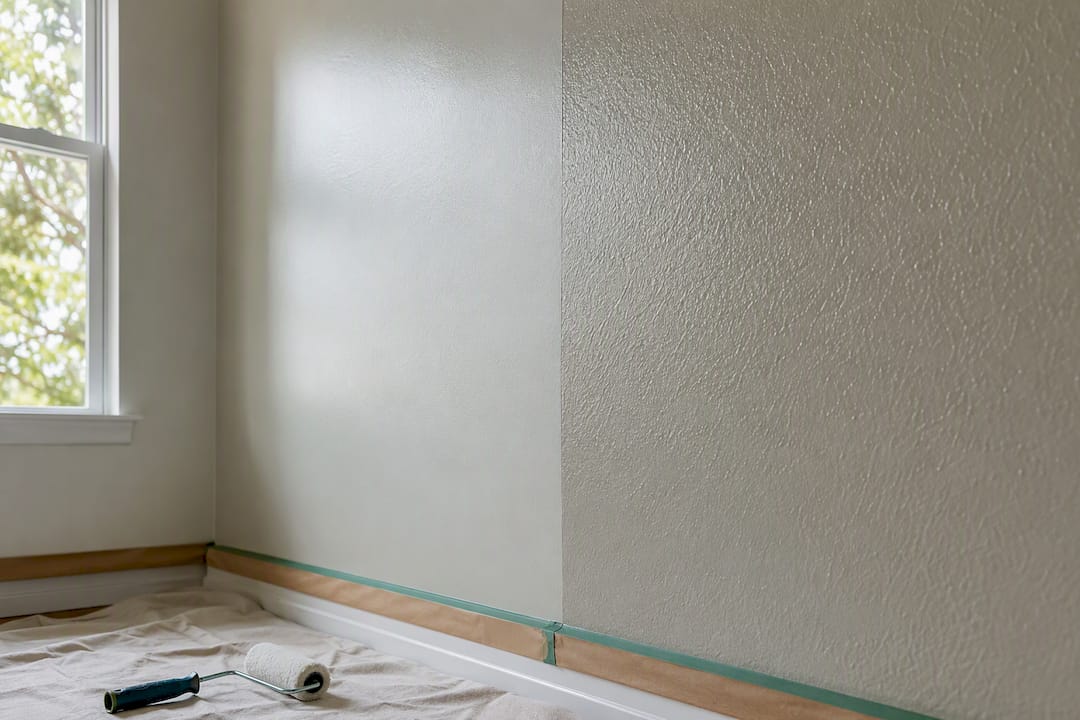
Textured surfaces, orange peel drywall, popcorn ceilings, brick, or stucco, scatter light in every direction regardless of the paint’s actual gloss rating. That scattering effect is part of why flat and matte finishes are the default for textured ceilings and rougher walls: a higher sheen on a bumpy surface creates uneven, patchy-looking highlights rather than a uniform shine.
Wood grain adds another variable. Raw or lightly sanded wood absorbs paint unevenly, which can leave a satin or semi-gloss coat looking dull in some spots and shinier in others until you apply a proper primer and sand between coats. This is a big reason cabinet and trim work benefits from extra prep. A smooth substrate is what lets semi-gloss and high-gloss finishes look sharp instead of blotchy. On heavily textured walls, matching the sheen to the texture matters more than matching it to the room’s traffic level.
Common Myths About Paint Sheen You Should Ignore
A lot of DIY confusion around sheen comes from a handful of persistent myths. The biggest one: that flat paint is always low quality and glossy paint is always better. Sheen and paint quality are separate things entirely. You can buy a premium flat paint and a cheap semi-gloss, and the flat product will likely outperform the cheap gloss in coverage and fade resistance.
Another common mix-up: assuming “eggshell” and “satin” are interchangeable. They’re not. Satin carries noticeably more reflection and washability, which matters in a kitchen or hallway where eggshell might not hold up as well over years of cleaning.
There’s also a myth that higher sheen always means a more modern look. Plenty of contemporary interiors lean on flat and matte walls specifically for that light-absorbing, textureless feel, then use gloss selectively on trim or an accent door for contrast.
Finally, some homeowners assume one sheen must be used throughout a room for it to look intentional. In reality, mixing sheens on purpose, matte walls with semi-gloss trim, is standard practice and part of why trim reads as crisp and defined against a softer wall finish.
VOC Levels and Environmental Factors Across Paint Sheens
Sheen level and VOC (volatile organic compound) content aren’t directly tied together the way people sometimes assume. Glossier paints have historically leaned on more resin to achieve that reflective film, which in some formulations meant higher VOC content, but that gap has narrowed considerably as manufacturers reformulate low-VOC and zero-VOC lines across every sheen category, flat through high-gloss.
What still holds true: oil-based paints generally carry higher VOC levels than water-based acrylics, regardless of sheen. If indoor air quality is a priority, particularly in a nursery, bedroom, or a home with respiratory sensitivities, choosing a water-based, low-VOC product matters more than which sheen you pick. Most major brands now offer zero-VOC options in flat, eggshell, satin, and semi-gloss, so you’re rarely forced to trade air quality for durability anymore.
Ventilation during and after application still matters no matter which sheen or VOC level you choose. Open windows, run fans, and give the space a day or two before moving furniture back in, especially with any oil-based or higher-VOC product.
Why the “Just Pick a Popular Sheen” Advice Falls Short
Most sheen guides hand you a room-by-room chart and call it done. That’s a fine starting point, but it skips the two things that actually determine whether your paint job looks professional: surface condition and application consistency. A satin finish on a poorly patched wall will look worse than a flat finish on the same wall, no chart accounts for that.
The PVC science matters more than most DIY content admits. Understanding that deep colors can nudge sheen upward, and that flatter bases exist specifically to counteract that, saves people from buying a second gallon when their “matte” accent wall turns out shinier than expected.
If there’s one thing worth prioritizing above sheen selection itself, it’s the sample patch test. Skipping it is the single most common regret among first-time painters, and it costs almost nothing to avoid. Prep work runs a close second. No sheen choice survives bad drywall prep or a rushed primer coat.
Contractor experience backs this up in a practical way: the pitfalls that show up most on real jobs, wrong sheen for the room’s moisture level, insufficient coats, skipped primer, aren’t sheen problems at all. They’re prep and process problems that happen to show up as sheen complaints.
— Noah
Sources
Recommended
Dealing With Something Similar?
Every property is different, but if this sounds like what you’re seeing, we’re happy to take a look and help you figure out what’s actually going on.