Roofing
Roofing Underlayment Types: Felt, Synthetic and Peel-and-Stick
By Noah Spagnotti

There are three basic types of roofing underlayment: asphalt-saturated felt, synthetic, and rubberized asphalt, which most people call peel-and-stick. InterNACHI lists the same three categories. Many asphalt shingle roofs use more than one of them: peel-and-stick in the leak-prone spots (eaves, valleys, penetrations) and felt or synthetic across the rest of the deck.
The layer is hidden under your shingles, so it rarely gets discussed. It still decides how your roof behaves in the first storm after a shingle blows off or an ice dam forms. Below is what each type is, where it belongs, what the code says, and what to ask your roofer before you sign.
TL;DR
Felt is the traditional, lower-cost option. Synthetic is lighter, covers more roof per roll and resists wrinkling. Peel-and-stick seals around nails, which is why it is used at eaves, valleys and roof penetrations.
Where ice dams are a known local problem, the residential code (IRC R905.1.2) requires an ice barrier at the eaves: either two layers of underlayment cemented together or a self-adhering sheet. Check with the City of Omaha Permits & Inspections for how that applies to your roof.
Peel-and-stick over the whole deck is not the default. It acts as a vapor retarder, so ventilation matters more when the entire deck is covered.
Ask your contractor which product goes where, and ask for photos of the clean deck and installed underlayment before the shingles cover them.
What underlayment does under your shingles
Underlayment is a secondary layer between the roof deck and the shingles. ARMA describes it as a second layer of protection that shields the deck from wind-driven rain. Shingles do most of the shedding, but they are not a sealed surface. Water can be pushed under them by wind, or backed up behind ice.
The Asphalt Roofing Manufacturers Association says asphalt shingles should not go directly on a wood deck; the deck should first be covered with underlayment. ARMA also notes that underlayment helps keep the deck dry until the shingles go on (which should happen as soon as possible), is a required part of a fire-classified roof assembly, and protects shingles from resins in wood-based sheathing.
The three main types of roof underlayment
Asphalt-saturated felt
Felt is an organic (cellulose) or fiberglass mat saturated with asphalt, and it is the traditional underlayment. ARMA notes that organic felt has historically been specified and widely used under asphalt shingles, and that ASTM D226 covers two types: Type I, commonly called No. 15 felt, and the heavier Type II, often called No. 30. InterNACHI adds that 30-pound felt is more resistant to damage during installation.
Its downsides are practical. Felt is heavier than synthetic and covers less roof per roll. InterNACHI notes that it is water-resistant but not waterproof, and that lower-quality felts absorb water and can wrinkle, which may telegraph through thinner shingles.
One point about the numbers: "15-pound" and "30-pound" are old trade names, not a guarantee. InterNACHI warns that some paper labeled "15-lb." or "30-lb." does not meet any ASTM standard. The code requires felt underlayment to carry a label showing the standard and type it meets. If a quote just says "15-pound felt," ask what product it is and which standard it is labeled to.
Synthetic underlayment
Synthetic underlayment is a non-bitumen sheet made from polypropylene or polyethylene. ARMA says synthetics are lighter than saturated felts yet typically cover more roof per roll. InterNACHI adds that they are strong, usually non-skid, wrinkle-free and UV-resistant, and that some can be left exposed for months depending on the manufacturer's instructions. They generally cost more than felt.
There is one caveat. InterNACHI notes that synthetics are typically considered moisture barriers, while organic felt allows some vapor to pass, and that installing a synthetic like felt instead of following its instructions can create moisture problems. Attic ventilation matters whichever product you choose; our guide to roof ventilation types covers the basics.
Rubberized asphalt (peel-and-stick)
This is the product you hear called ice and water shield, ice barrier, or peel-and-stick. Fine Homebuilding notes that these membranes have been used since the mid-1970s and go by many names and brands.
The key feature is the self-adhering back. Fine Homebuilding's guide explains that the sticky layer that bonds the membrane to the sheathing also seals around nail shanks, which makes it useful where ice dams or wind-driven rain can push water under shingles, and as backup for flashing. ARMA lists the same uses: eaves, ridges, hips, valleys and penetrations such as vents, skylights and chimneys. These membranes cost more and act as vapor retarders, so they are usually placed where they are needed rather than everywhere. Follow the membrane and shingle manufacturers' instructions for the deck and weather conditions.
Felt vs. synthetic vs. peel-and-stick at a glance
Asphalt felt | Synthetic | Peel-and-stick | |
|---|---|---|---|
Material | Asphalt-saturated paper or fiberglass mat | Polymer sheet, no asphalt | Rubberized asphalt with a sticky back |
Relative cost | Lowest | Middle | Highest per square foot |
Weight and handling | Heavier, less coverage per roll | Lighter, more coverage per roll | Sticky, needs a clean dry deck and careful placement |
Vapor behavior | Some vapor can pass (organic felt) | Typically a moisture barrier | Acts as a vapor retarder |
Best use | Whole deck on a budget | Whole deck, longer exposure during work | Eaves, valleys, chimneys, vents and other penetrations |
Actual material prices depend on brand and roll size, so treat the cost row as a general ranking, not a price list.
Synthetic vs. felt: which should cover the main roof?
For most homeowners, this is the real decision. Both can work under asphalt shingles when the product is accepted under the local code and installed per the shingle and underlayment manufacturers' instructions. ARMA notes that some underlayment products may not be approved by the code in every area, so ask how the product in your quote is approved. The difference shows up in how the roof is built and how long it sits open.
Choose felt if the budget is tight and the roof will be dried in quickly. It is a proven product.
Choose synthetic if you want lighter rolls, fewer seams and more tolerance for a delay between tear-off and shingles (within the product's stated exposure limit). Check the attic ventilation first.
Ask about a mix. A well-planned roof often uses peel-and-stick at the edges and valleys, with felt or synthetic across the field.
If you are comparing quotes, compare the product's stated standard and type and its installation instructions, not the old weight label. A quote that does not name the product is hard to compare.
Ice and water shield vs. felt
They do different jobs. Felt sheds water but does not seal around nails. ARMA explains that self-adhering membranes seal around the shanks of the shingle nails, so water that backs up from an ice dam is unlikely to pass through even though many nails penetrate the membrane.
That is why Building Science Education guidance for cold climates (Climate Zones 5 and higher) calls for a self-sealing membrane along the eaves to protect against ice dams, extending at least two feet in from the interior plane of the wall. Omaha is in Climate Zone 5. The code sets a minimum too: IRC Section R905.1.2 requires an ice barrier where there is a history of ice forming along the eaves, made of at least two layers of underlayment cemented together or a self-adhering polymer-modified bitumen sheet, running from the eave to at least 24 inches inside the exterior wall line (and at least 36 inches up the slope on roofs of 8:12 or steeper). Check with the City of Omaha Permits & Inspections for how the requirement applies to your roof.
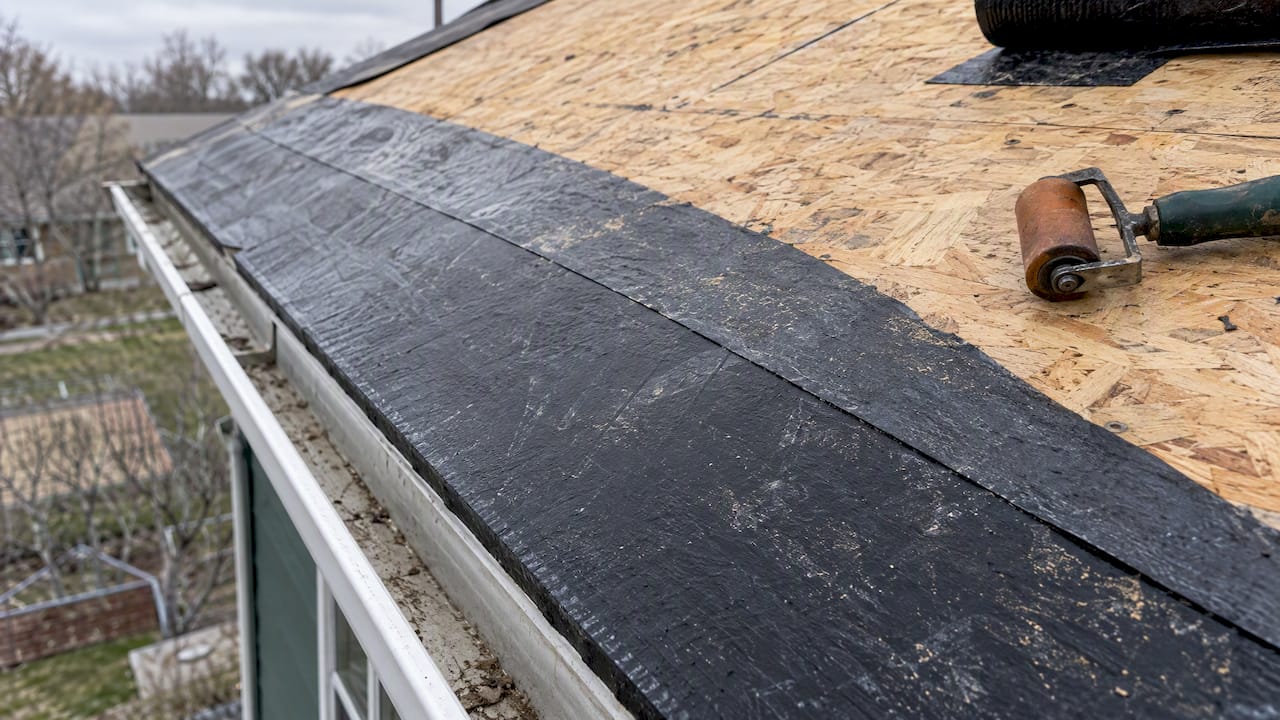
If you have had ceiling stains near the exterior walls in winter, the underlayment at the eaves is only one part of the fix. Attic air sealing, insulation and ventilation matter too.
Where each underlayment goes on a roof
A well-planned roof matches the product to the risk, area by area.
Eaves: peel-and-stick, because ice dams form here. Our drip edge guide explains how the layers switch at the eaves and rakes.
Valleys: a valley lining under the valley metal or shingles, since water concentrates here. The code allows several linings, including self-adhering membrane. If you have repeat leaks, see our article on roof valley leaks.
Chimneys, skylights, vents and wall intersections: peel-and-stick, tied into the flashing. Our overview of roof flashing types shows what goes where.
The open field of the roof: felt or synthetic.
The order matters. Fine Homebuilding's Mike Guertin describes applying peel-and-stick strategically and integrating it with conventional underlayment and shingles to block and shed water, and the code calls for underlayment to be applied shingle fashion, starting at the eave. Each layer should shed water onto the next one, not under it.
Should the whole roof get peel-and-stick?
Sometimes, but not by default. The code allows a full self-adhering underlayment as an alternative when it is installed per both the underlayment and roof covering manufacturers' instructions for the deck, ventilation and climate. ARMA cautions that self-adhering underlayments act as vapor retarders, that ventilation becomes more important when they cover the entire deck, and that inadequate ventilation may contribute to premature deterioration of the roof system and deck.
If a contractor proposes full-deck peel-and-stick, ask why and ask how the attic will ventilate. A good answer names the roof slope, the product's manufacturer instructions, and the vents.
What the code and inspections mean for your roof
Omaha builds to the 2018 International Residential Code with local amendments. A few points in the Omaha edition of Chapter 9 bear on underlayment:
Felt underlayment under asphalt shingles must meet one of the listed standards (ASTM D226, D4869 or D6757) and carry a label showing the standard and type.
Asphalt shingles go only on solidly sheathed decks.
A roof replacement includes removing the existing roof coverings down to the deck. An existing ice barrier that is adhered to the deck may stay in place and be covered with a new layer of ice barrier.
A roof recover (new shingles over old) is not allowed.
Permit and inspection details change, so check with the City of Omaha Permits & Inspections before your project. Either way, ask your contractor for photos of the clean deck and the installed underlayment. They are the only record of what is under your shingles once the roof is finished.
Winter installs and underlayment
Roofs get replaced in cold months too. Self-adhered membranes need a clean, dry deck, and cold weather can keep shingles from sealing down on their own. Both the membrane and shingle manufacturers publish cold-weather instructions, including when shingles need to be hand-sealed. If you book a winter project, ask how the crew follows them.
Our perspective
Underlayment is a planning decision, not a line item to minimize. A roof can look the same from the street whether the work underneath was careful or rushed. The difference shows up years later, at a valley, a chimney, or the first ice dam.
A sound starting point for most homes is the one the code points to: an ice barrier at the eaves, the right lining in the valleys and at penetrations, a listed underlayment across the field, and attic ventilation that is checked before anything is covered.
If a quote is vague about underlayment, treat that as a flag. It is a reasonable question, and a good contractor will answer it in writing.
What a roof replacement costs, and where underlayment fits
Our published roofing prices: roof replacement starts at $5.50+ per sq. ft. for standard architectural shingles, $6.00+ for Class 3 impact-resistant shingles and $6.50+ for Class 4 SBS-modified shingles, with a $7,500 minimum project. Roof repairs start at $595+ per visit for a small repair and $995+ for a standard repair. A roof leak assessment is $195 and is credited toward an approved repair of $595 or more when scheduled within 30 days. Underlayment is part of the replacement scope, and final pricing depends on measured roof area and conditions. If you are not sure whether a leak is a shingle problem or an underlayment and flashing problem, the assessment is a sensible first step.
For an estimate in the Omaha metro, start at our roofing page.
Questions to ask your roofer before signing
Which underlayment will you use on the main field, and which at eaves, valleys and penetrations?
What is the ice barrier made of, and how far in from the exterior wall line will it run?
Will you send photos of the clean deck and the installed underlayment?
How is the attic ventilated after the new roof is on?
If the job happens in winter, how do you follow the cold-weather instructions for the membrane and shingles?
Is drip edge going in at the eaves and rakes, and in what order relative to the underlayment?
FAQ
What is the best roof underlayment for asphalt shingles?
There is no single best product. A common, sound approach is peel-and-stick at eaves, valleys and penetrations, with felt or synthetic across the rest of the deck. Pick based on budget, how long the roof may sit open, and your attic ventilation.
Is synthetic underlayment better than felt or tar paper?
Synthetic is lighter, covers more roof per roll and generally handles exposure better. Felt costs less and is a proven material, and "tar paper" is simply a common name for it. Synthetics are typically moisture barriers, so confirm the attic is ventilated before you choose one.
Do I need ice and water shield in Omaha?
Expect one at the eaves. The 2018 IRC (Section R905.1.2) requires an ice barrier in areas the local jurisdiction designates as having a history of ice forming along the eaves. It can be two layers of underlayment cemented together or a self-adhering membrane. Confirm the details with your contractor and the City of Omaha Permits & Inspections.
Can I put new underlayment over the old one?
Generally no. Under the Omaha edition of the 2018 IRC, a roof replacement removes the existing roof coverings down to the deck, and a roof recover is not allowed. The exception is an existing ice barrier membrane adhered to the deck, which may stay and be covered with a new layer of ice barrier.
What does "15-pound" or "30-pound" felt mean now?
They are trade names. ASTM D226 Type I is commonly called No. 15 felt and Type II No. 30, but some products labeled "15-lb." or "30-lb." don't meet any standard. Ask for the product name and the standard it is labeled to.
Sources
The Basics of Peel-and-Stick Roof Underlayment, Fine Homebuilding
Installing Self-Sealing Membrane at Eaves, Building Science Education
Chapter 9 Roof Assemblies, Omaha Residential Code 2018 (2018 IRC), UpCodes
Recommended
Dealing With Something Similar?
Every property is different, but if this sounds like what you’re seeing, we’re happy to take a look and help you figure out what’s actually going on.