General Contracting
Gutter Hanger Types: How to Choose the Right One
By Noah Spagnotti

There are five main gutter hanger types: hidden hangers, spike and ferrule, brackets, strap hangers and roof-mounted (T-bar) hangers. For most homes with seamless K-style gutters, hidden hangers screwed into solid wood are the best choice. Spike and ferrule still shows up on older houses, but it is the style most likely to work loose. In a climate like Omaha's, with freeze-thaw cycles and heavy snow and ice, the hanger you pick and how closely you space it matter as much as the gutter itself.
TL;DR
Hidden hangers are the modern standard for K-style gutters: they clip inside the trough and screw into the fascia, so nothing shows from the ground.
Spike and ferrule is the legacy method. Metal moves with temperature, and spikes in wood fascia tend to loosen over the years.
Bracket and strap styles suit half-round and historic profiles. Roof-mounted hangers solve the problem of homes with no usable fascia.
Manufacturer installation instructions commonly call for a hanger every 24 inches, and every 18 inches where heavy ice and snow are common.
Screws beat nails, and fastening into solid framing beats fastening into thin or soft fascia.
What a gutter hanger actually does
A gutter full of water is heavy. A 5-inch gutter section holding rain, leaves and then a layer of ice pulls down and away from the house with real force. The hanger is the only thing resisting that pull, and it also holds the slope that moves water toward the downspout.
That is why a sagging gutter is rarely a gutter problem. Usually the cause is too few hangers, a fastener that has worked loose, or soft wood behind the gutter. If your gutters pull away, pond water, or overflow at one spot, start by looking at what holds them up.
The two broad families are fascia-mounted and roof-mounted. Fine Homebuilding groups the many variations into those two categories: roof-mounted hangers use a strap nailed to the roof sheathing, and fascia-mounted hangers screw or nail to the fascia board or rafter tails.
The main gutter hanger types
Here are the five common hanger types and how they compare in practice.
Type | How it attaches | Best for | Main drawback |
|---|---|---|---|
Hidden hanger | Clips inside the trough; a screw passes through the back into the fascia | K-style seamless gutters | Needs solid wood behind it and proper screws |
Spike and ferrule | A long spike runs through a sleeve (ferrule) and the front of the gutter into the fascia | Older homes, budget repairs | Loosens as metal expands and contracts |
Bracket | A bracket cradles the gutter and fastens to the fascia, often visible | Half-round gutters, heavy loads | More visible, higher material cost |
Strap hanger | A strap wraps under the gutter and fastens to the fascia or roof edge | Half-round and historic profiles | Visible, takes more labor |
Roof-mounted (T-bar) | Fastens to the roof deck under the shingles and suspends the gutter | Homes with no fascia or a weak one | Requires working under roofing |
Hidden hangers
Hidden hangers sit inside the gutter and are fastened through the back of the trough into the fascia. Nothing shows from the ground, and Fine Homebuilding notes that hidden hangers are favored for K-style aluminum gutters: they can be set in the gutter on the ground and fastened to the fascia with their integral screws. The same source points out that because they clip inside the channel rather than supporting it from below, they work best with heavier 0.032-inch gutter stock, which is stiffer and less likely to sag. Unlike spikes, they also do not punch a hole through the front face of the gutter.
Their performance depends on the install. A hidden hanger screwed into rotted or thin fascia is no better than a spike in the same board.
Spike and ferrule
This is the classic system: a spike goes through the front face of the gutter, through a tube (the ferrule) that spans the inside of the trough, and into the fascia. The ferrule keeps the gutter from being crushed as the spike is driven.
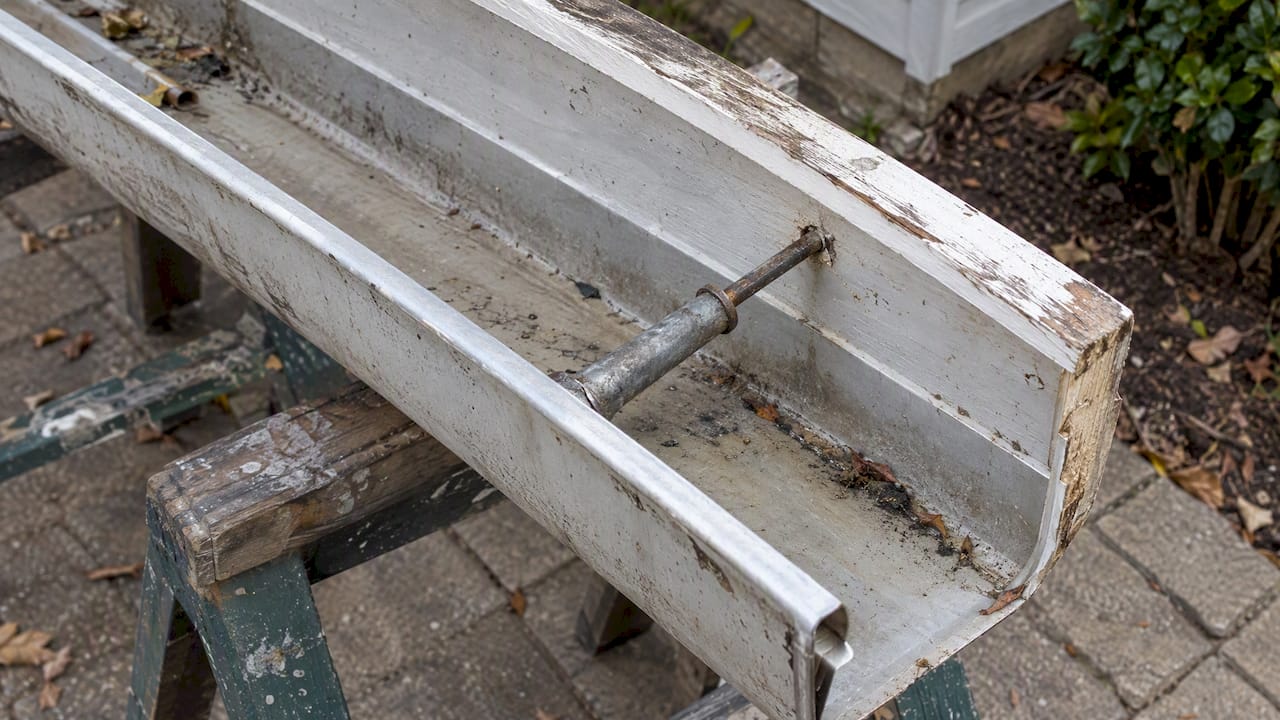
It works, and it is cheap. The trouble is time. Gutters expand and contract through hot summers and freezing winters, and the spike works back and forth in wood that is itself swelling and shrinking. Over the years the hold gets looser. Fine Homebuilding notes that critics of spike-and-ferrule hangers point out that the long spikes leave large holes, encourage rot, and in the end don't hold well. If you see small dark streaks or gaps along the top of your fascia, or a gutter that rocks when you push it, spikes are the first suspect.
Brackets
A bracket supports the gutter from beneath and is fastened to the fascia. Fine Homebuilding notes that bracket hangers are usually screwed to fascia boards, and because they can be mounted first along a chalkline, the gutter can then simply be set into them. Brackets are a good fit when the gutter will carry unusual weight, such as a long run beneath a large roof plane with no downspout in the middle.
Strap hangers
Straps wrap beneath the gutter and tie back to the fascia or roof edge. They are the traditional match for half-round gutters and for historic homes where the look of the hardware is part of the character. They are visible, though, and they take longer to install, so you will pay for that labor.
Roof-mounted hangers
Some houses have no fascia board at all, or one too damaged to hold a screw. Roof-mounted hangers (often called T-bar or strap hangers) fasten to the roof sheathing under the shingles and carry the gutter from above. Fine Homebuilding calls them the only option when there's no fascia and suggests nailing them to the sheathing during a reroof, with shingles applied over them, so they are best done at the same time as roof work. If you are replacing shingles anyway, ask your roofer about it. Our roofing team can coordinate both.
Which type fits which gutter?
Pick the gutter profile first, then the hanger.
K-style seamless aluminum: hidden hangers. This is what most Omaha-area homes built in the last few decades have, and it is what we install.
Half-round: brackets or straps, because the shape does not take a clip-in hanger the same way.
Older K-style with spikes: if the fascia is sound, you can often upgrade by replacing spikes with screw-in hidden hangers during a repair. If the fascia is soft, repair the wood first.
No fascia or rotten fascia: roof-mounted hangers, or new fascia and then hidden hangers.
Gutter hanger spacing
How many hangers you need depends on the gutter, the roof size and the weather. The numbers that come up most:
24 inches on center is what gutter manufacturers' installation instructions commonly call for.
18 inches is what those same instructions call for in heavy ice and snow areas.
32 inches is the outer limit: Fine Homebuilding says gutter sections need hangers at least every 32 inches, and closer under a heavy snow or ice load.
The sources agree on the direction: tighter is safer, and in a snowy climate you should not stretch spacing to save a few dollars.
For Omaha, with real winters, we plan on the 18 to 24 inch range. Closer spacing also helps if you have long runs under big roof valleys, where water volume spikes in a storm. Put an extra hanger near corners and near downspout outlets, where the load concentrates.
Spacing is a count of hangers per run. A 40-foot run at 24 inches takes about 20 hangers. At 18 inches it takes about 27. The difference in materials is small compared with the cost of redoing a sagging run.
Fasteners and what they hold into
The hanger is only as good as the screw and the wood behind it.
Use screws, not nails. Nails and spikes can back out over time as the board moves, while a screw threads into the wood and holds.
Hit solid wood. Fine Homebuilding notes that gutters are less likely to pull free when hangers are fastened to the framing behind the fascia. If the fascia is thin or suspect, the screw should reach the rafter tails behind it. A screw that only bites a thin, tired board will not carry a gutter full of ice.
Check the wood before you hang anything. Any rot in the fascia means repairing the board first. New hangers driven into soft wood will not hold for long.
It is the same logic you see in other exterior carpentry: the right fastener into the right structure beats a quick fix. If a railing or deck connection feels loose, our guide on repairing the connection instead of tightening bolts applies the same idea.
Slope and downspouts still matter
Perfect hangers will not save a gutter hung level or tilted the wrong way. Water needs a slight fall toward the downspout, and standing water adds weight and freezes. We cover the numbers in our guide to gutter slope requirements homeowners can check.
Where the water goes afterward matters too. A gutter that empties beside the foundation just moves the problem. See fixing downspout drainage around your home for what to do at the bottom of the pipe.
Signs your hangers are failing
Walk around the house after a rain, and look for these:
A gutter that dips in the middle or pulls away from the fascia at the top edge.
Water spilling over the front lip in one stretch while the rest of the run is dry.
Spikes visible and backing out, or dark streaks and gaps along the fascia.
Peeling paint or soft spots on the fascia board right behind the gutter.
Ice dams or heavy icicles that seem to tug the gutter downward in winter.
One loose hanger can be replaced. If the problem repeats along a run, you are likely looking at spacing that was too wide, the wrong hanger type for the gutter, or fascia that cannot hold a fastener. Those are fixes for a pro, because a ladder, a heavy section of metal and a roof edge are a poor combination. Hail can also damage gutters and roofing together, so it is worth running through our 15 minute hail check after a storm.
Our perspective on hangers in Omaha
We see the same pattern on service calls: homeowners blame the gutters when the real problem sits behind them. A gutter pulled away from the house is almost always a hanger, a fastener or a fascia problem.
Here is how we think about it at Spagnotti Contracting:
Plan before you hang. We look at the fascia, the roof size and the run lengths first, then choose the hanger and spacing to suit. A gutter job is part of the whole exterior, not a standalone task.
Hidden hangers on K-style, screwed in. It is the cleanest look and the strongest hold for the seamless gutters most homes here have.
Tighter spacing for winter. We would rather add a few hangers than come back after the first ice storm.
Fix the wood first. No hanger fixes rot. If the fascia is soft, you will hear that from us before any new gutter goes up.
Say what we found. We explain what we found behind the metal, and the finished gutters are reviewed together at the end, so you know what was done where you cannot see it.
The cheapest hanger is rarely the cheapest outcome. A gutter job done right once costs less than doing it twice.
Replacing or upgrading gutters with Spagnotti Contracting
If your gutters sag, leak at the seams or are held up with old spikes, we can look at the whole system: hangers, fascia, slope and downspouts. We are licensed and insured and install seamless K-style gutters across the Omaha metro area: 5-inch seamless gutters are listed at $13–15 per linear foot and 6-inch at $15–18 per linear foot installed, with a $1,500 project minimum. Gutter repairs start at $495 per service visit, and more involved repairs start at $895. Details are on our gutter installation and repair page.
If you have roof or siding work coming, it often makes sense to plan the gutters alongside it, since all three meet at the roof edge. Ask us for an estimate.
FAQ
Are hidden hangers better than spike and ferrule?
For most homes, yes. Hidden hangers are screwed in and do not punch through the face of the gutter, so they hold better through temperature swings. Spike and ferrule can work on sound fascia, but it is the method most prone to loosening over time.
How far apart should gutter hangers be?
Gutter manufacturers' installation instructions commonly call for one hanger every 24 inches, or every 18 inches in heavy ice and snow areas, and Fine Homebuilding says hangers should be no farther apart than 32 inches. In the Omaha area, plan on the tighter end.
Should gutters be nailed or screwed in?
Screwed in. Nails can back out as wood and metal move through the seasons, while screws that reach solid wood hold much better. If the fascia is thin, the screw should reach the rafter tails behind it.
Can I switch hanger types on existing gutters?
Often yes, as long as the fascia is sound. Replacing old spikes with screw-in hidden hangers is a common upgrade. If the board is rotted, repair that first, or consider roof-mounted hangers.
Sources
Recommended
Dealing With Something Similar?
Every property is different, but if this sounds like what you’re seeing, we’re happy to take a look and help you figure out what’s actually going on.