General Contracting
Prevent Leaks: Cement Board vs Greenboard Rules Every Homeowner Needs
By Noah Spagnotti

Cement board goes in your shower, tub surround, and anywhere water hits the wall directly. Greenboard is fine for damp buffer zones like a vanity wall or a ceiling above the tub, but not for anything that gets wet regularly. Building codes back this up: greenboard doesn’t meet modern code requirements for wet areas. Even cement board needs correct joint treatment and, in most shower builds, a waterproofing membrane on top.
TL;DR:
Cement board is essential for wet zones like showers and tub surrounds due to its waterproof properties and ability to handle heavy tile loads without degrading.
Greenboard is suitable only for buffer zones such as ceilings or walls near showers that do not receive direct water spray, but it should never be used where water contact is continuous.
Proper installation of joint sealing, seam treatment, and membrane application significantly reduces water infiltration, regardless of whether cement board or greenboard is used.
Using alkali-resistant screws and following manufacturer guidelines for fastener spacing and joint treatment are critical for long-term durability and water resistance.
A precise zone mapping and understanding of each material’s limitations prevent unnecessary costs and failures, especially when opting for greenboard in non-wet areas or adding membranes where needed.
Spagnotti Contracting
Plan Your Bathroom Remodel With Confidence
Spagnotti Contracting provides detailed planning, quality workmanship, and clear communication for residential remodeling projects in the Omaha metro area.
Table of Contents
Cement Board: What It Is and Why It Handles Water Better
Greenboard: Where It Helps and Where It Fails
Cement Board vs. Greenboard: The Differences That Actually Matter
Where to Use Each Board (and What Else Exists)
A Homeowner Checklist for Choosing the Right Substrate
Installation and Waterproofing Basics Worth Knowing
How Spagnotti Contracting Applies These Rules on Real Jobs
The Bottom Line on Cement Board vs. Greenboard
What Homeowners Get Wrong About This Decision
Let Spagnotti Contracting Handle the Substrate Decisions
Sources
Cement Board: What It Is and Why It Handles Water Better
Cement board is a Portland cement core reinforced with fiberglass mesh, built to comply with standards like ANSI A118.9 and ASTM C1325. That composition is why it doesn’t rot, swell, or break down when it stays wet for years. It also grips thin-set mortar better than gypsum-based products, which matters when you’re hanging heavy porcelain or natural stone. For heavy-format tile or stone, the added rigidity of cement board helps prevent grout cracking that lighter substrates can’t control.
None of that comes free. Cement board is heavy, often requiring two people to lift and set a full sheet. Cutting it kicks up silica dust, so you need a respirator and, ideally, carbide tools rather than a standard utility knife. Installers also need alkali-resistant screws, since regular drywall fasteners corrode in the cement matrix. A few practical notes worth knowing before you buy:
Sheets typically run heavier per square foot than gypsum board, so budget for extra help on install day.
Fastener spacing and joint treatment should follow manufacturer guidance, similar to what USG’s Durock system guide lays out.
Material costs run higher than greenboard, but the payoff shows up years later when the wall behind your tile hasn’t rotted.
Greenboard: Where It Helps and Where It Fails
Greenboard is standard gypsum board with a treated, wax based face paper designed to shrug off humidity and resist mildew. It is not designed to survive standing water or direct spray, and that distinction trips up more DIYers than any other detail in this comparison.
The appeal is real. Greenboard is light enough for one person to carry and hang, cuts with a utility knife instead of carbide blades, costs noticeably less per sheet, and takes paint and standard joint compound without any special prep. It remains a practical choice in non-wet bathroom areas precisely because it is so easy to work with.
The weaknesses show up the moment water gets past the surface:
The gypsum core softens and loses strength once it absorbs moisture, rather than shedding it.
Cut edges are unprotected gypsum, and they wick water even faster than the face.
Code guidance does not treat greenboard as an acceptable tile backer inside a shower footprint, no matter how well it’s installed.
Cement Board vs. Greenboard: The Differences That Actually Matter
The material difference drives everything else. Cement board’s cement and fiberglass structure holds its shape wet or dry, while greenboard’s gypsum core degrades once water gets past the face paper. That single fact explains why one survives a leak and the other doesn’t.
Here’s how the two stack up on the questions homeowners actually ask before buying:
Tile adhesion. Cement board bonds tightly with thin-set and handles the weight of stone or large-format porcelain. Greenboard works fine with lighter ceramic tile in dry zones but isn’t rated for heavy wet-area installs.
Leak tolerance. If water gets behind the tile, cement board stays structurally sound long enough for you to catch and fix the problem. Greenboard starts breaking down, often silently, inside the wall cavity.
Installation labor. Cement board demands carbide tools or a score-and-snap technique, dust control, and often two people per sheet. Greenboard cuts and hangs almost exactly like standard drywall.
Fasteners. Cement board needs alkali-resistant screws designed for the cement matrix. Regular drywall screws corrode and fail over time. Greenboard accepts standard drywall screws without issue.
Cost. Cement board sheets cost more upfront, and installation labor runs higher because of the extra cutting time and handling. Greenboard is the cheaper, faster option, but only appropriate outside true wet zones.
Pro Tip: “Water-resistant” and “waterproof” are not the same claim. Greenboard is water-resistant; cement board is also water-resistant, not waterproof, on its own. Experts draw a hard line between the two terms, and that’s exactly why most shower assemblies pair cement board with a separate membrane rather than trusting the board alone to keep water out of the wall cavity.
Joints are the weak point in either system. Seam and joint vulnerability is the main way water gets behind a substrate, which is why taped seams, thin-set coverage, and a membrane matter more than which board you picked in the first place.
Where to Use Each Board (and What Else Exists)
Wet zones are the parts of your bathroom that see standing water or direct spray: shower interiors, tub surrounds, and shower floors. Cement board is the right call there, full stop, and pairing it with a membrane is the standard approach for long-term durability.
Damp or buffer zones are everything nearby but not directly hit: vanity walls, the ceiling above a shower, and laundry room walls near a washer. Greenboard works fine in those spots, and it saves you money and labor compared to cement board.
A few alternatives are worth knowing before you commit:
Glass-mat gypsum backers (like DensShield) offer a lighter, easier-to-cut option that still resists moisture better than standard greenboard.
Foam backer boards are lightweight, waterproof at the panel level, and popular for steam showers because they don’t require a separate membrane in some assemblies.
Liquid waterproofing membranes applied over cement board give you a fully sealed system, which matters most under heavy stone tile or in steam enclosures where humidity never really drops.
If you’re planning a steam shower or setting large stone tile, talk through the substrate choice before you buy materials. Those two cases push past standard cement-board-plus-membrane and often call for a specialized panel system.
A Homeowner Checklist for Choosing the Right Substrate
Work through these steps before you buy a single sheet:
Map the zone. Walk the bathroom and mark where water actually hits: direct spray, splash, or just ambient humidity.
Weigh your tile. Natural stone and large-format porcelain need the rigidity cement board provides; standard ceramic in a dry zone doesn’t.
Check the substructure. Confirm your studs and blocking can support the extra weight of cement board where it’s needed.
Account for ventilation. A bathroom with a weak exhaust fan sees more ambient moisture, which pushes more of the room into “damp zone” territory.
Plan waterproofing before you tile. Decide on a membrane approach now, not after the board is already screwed to the studs.
Budget for alkali-resistant tape, the right thin-set or mortar for your tile type, a membrane product if you’re going that route, corrosion-resistant fasteners, and a respirator for any cement board cutting.
Some situations are worth handing off. If you’ve never worked with waterproofing membranes, if the tile is heavy enough to need an awkward two-person lift, or if you’re designing a steam shower, bring in a contractor. When you do call one, ask directly about their membrane approach, what fastener system they use, and what warranty covers the substrate versus the tile work.
Installation and Waterproofing Basics Worth Knowing
Seams are where most failures start, not the board itself. Tape every joint with alkali-resistant mesh, cover it with thin-set, and seal any cut edges on cement board before tile goes up. Fasteners should be spaced per manufacturer instructions and countersunk slightly so the tile sits flat.
On waterproofing, you generally have two paths: a membrane applied behind the board before it goes up, or a surface-applied membrane painted or rolled directly over the cement board once it’s installed. Traditional shower pans often use the first method; tiled steam showers usually call for the second, since steam pushes moisture harder than a standard shower spray ever does.
Cutting safety differs sharply between the two materials. Cement board needs a respirator and dust control because of silica content, along with carbide-tipped tools or a score-and-snap technique that leaves a rougher edge than a power saw. Greenboard cuts cleanly with a basic utility knife and score-and-snap method, no special dust precautions required.
The mistakes that cause callbacks are predictable:
Using greenboard anywhere water hits it directly, even “just this one spot.”
Leaving cut edges on cement board unsealed before tiling over them.
Grabbing standard drywall screws instead of alkali-resistant fasteners for cement board.
How Spagnotti Contracting Applies These Rules on Real Jobs
On a bathroom remodel, the substrate decision happens before demo starts, not after. Spagnotti Contracting maps out wet zones versus buffer zones for each project, then matches the board and membrane approach to what the client’s tile and layout actually demand.
For a standard shower surround, that usually means cement board paired with a membrane system. For a steam shower or a build using large-format stone, the team sometimes shifts to a glass-mat backer or a different membrane sequence depending on how the enclosure is designed. Cutting cement board on-site always means dust control and proper PPE, no shortcuts, since silica exposure isn’t worth risking for a faster afternoon.
Every substrate choice gets tied back to what the tile and moisture level require, not just what’s cheapest on the material invoice.
The Bottom Line on Cement Board vs. Greenboard
Cement board belongs in wet zones, greenboard belongs in buffer zones, and skipping the membrane step anywhere it’s needed is how leaks start. Map your bathroom’s zones first, then either pick your substrate or request a bathroom remodeling estimate if you’d rather have a pro handle it.
What Homeowners Get Wrong About This Decision
Most homeowners treat this like a binary choice: pick the “good” board and you’re covered. That’s not how it works. The board is one layer in a system that includes fasteners, joint treatment, and a membrane, and a cheap board installed correctly often outperforms an expensive board installed sloppily.
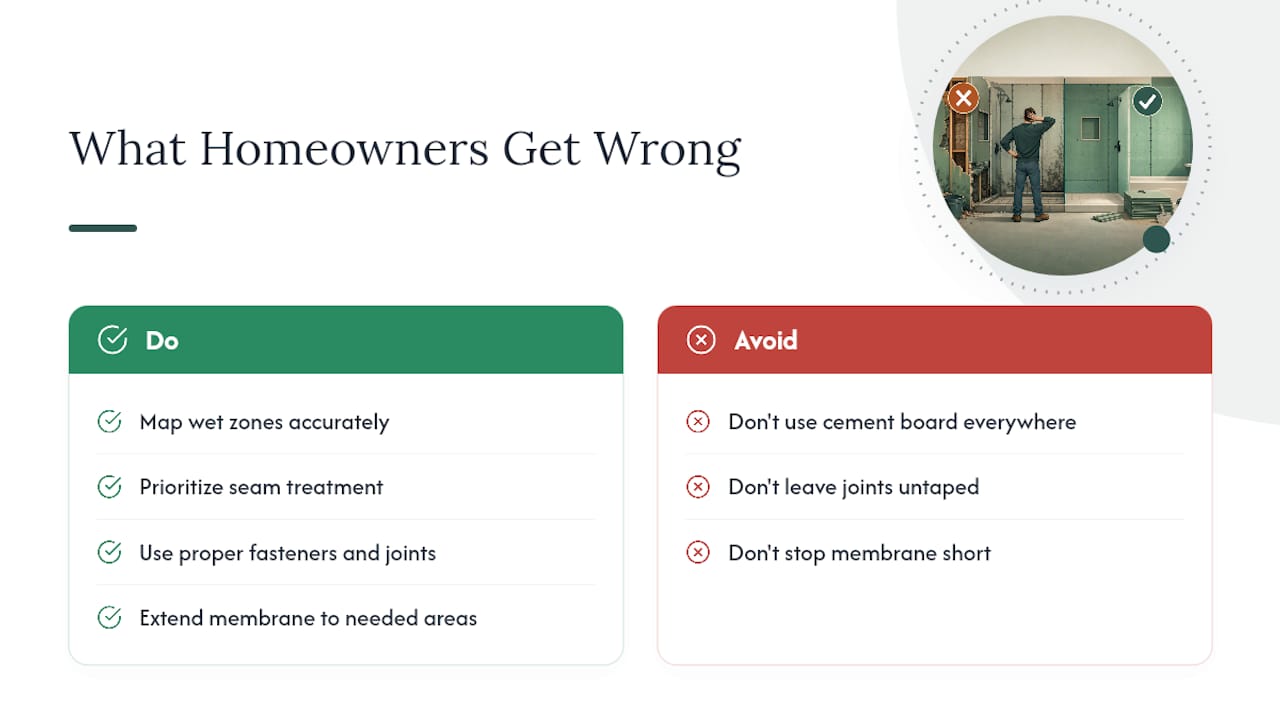
The bigger blind spot is the buffer zone. People assume anything near a shower needs cement board “just to be safe,” which wastes money and adds unnecessary weight to walls that don’t need it. A vanity wall six feet from the tub doesn’t need the same substrate as the shower pan itself. Zone mapping isn’t just a code technicality. It’s the fastest way to avoid both under-building and over-spending.
If there’s one thing worth prioritizing above the board choice itself, it’s the seam treatment. A leak almost never starts because someone picked greenboard instead of cement board in a truly dry zone. It starts at an untaped joint, an unsealed cut edge, or a membrane that stopped six inches short of where it needed to go. Get the zones right, get the seams right, and the board choice mostly takes care of itself.
— Noah
Let Spagnotti Contracting Handle the Substrate Decisions
Getting the zone mapping, membrane placement, and fastener choice right on your first attempt is harder than it looks, especially under a tile pattern you can’t easily undo. Professional contractors handle substrate selection, waterproofing, and tile-ready installation as part of a full bathroom remodel, so you’re not left guessing whether your seams are actually sealed before the tile goes on.

The team scopes tile weight, ventilation, and moisture exposure before recommending cement board, a glass-mat backer, or a membrane system for your specific layout, then manages the project from framing through finish. If you’re weighing tile options for the same remodel, this guide to bathroom tile choices pairs well with the substrate decision. For homeowners tackling wall finishes elsewhere in the house, this comparison of drywall and plaster is worth a look too. Ready to move forward? Request a bathroom remodeling estimate from a qualified contractor and get a plan built around your exact layout, not a generic checklist.
Sources
WCONLINE — IRC determines greenboard unsuitable for wet areas
BASC/PNNL resource guide — cement board installed behind tile and panel tub and shower enclosures
Recommended
Dealing With Something Similar?
Every property is different, but if this sounds like what you’re seeing, we’re happy to take a look and help you figure out what’s actually going on.