General Contracting
Crown Molding vs Cove Molding: Which One Fits Your Room?
By Noah Spagnotti
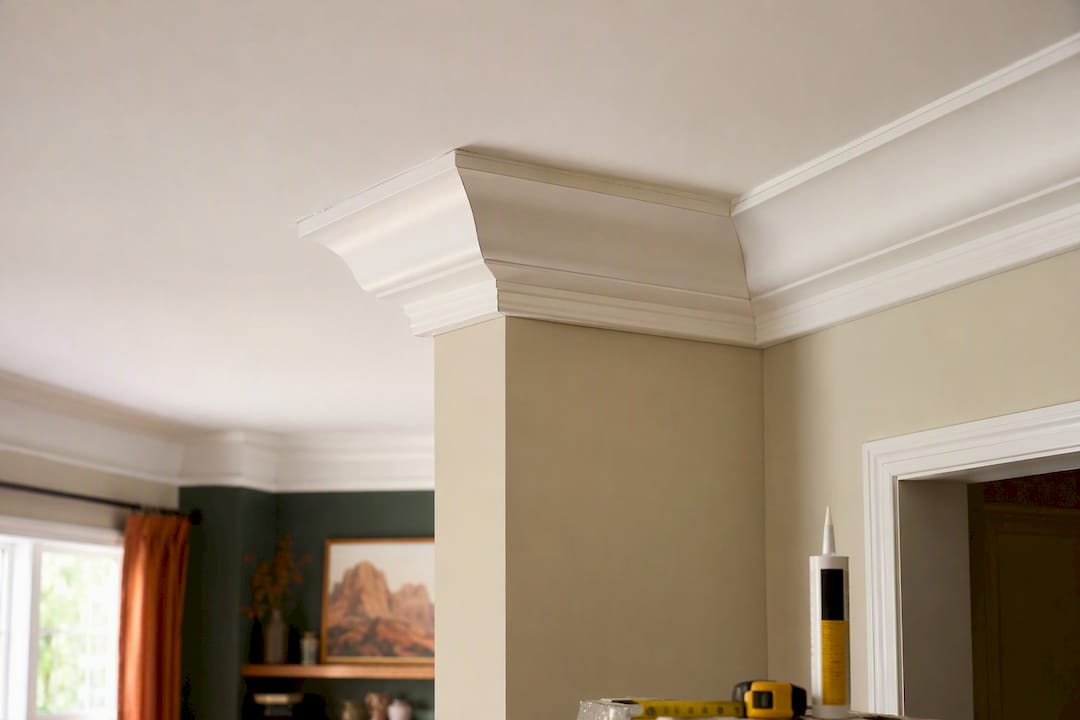
Choose crown for a formal, ornate look and cove for a simple, subtle transition. Crown’s compound curve projects outward and suits taller ceilings and traditional rooms, while cove’s plain concave profile hugs the corner and works in tighter spaces or wherever you want the wood grain to show. Pick cove instead of crown when:
Your ceilings run under 8 feet and a bold profile would feel cramped
You’re trimming stair treads, cabinet tops, or a bathroom where moisture matters
You want a quick, budget-friendly DIY weekend project
Key Takeaways
The right molding choice depends on matching profile shape and scale to your ceiling height, room formality, and installation skill. Crown generally suits formal, taller rooms and projects outward, while cove fits simpler, smaller spaces with its concave profile. Material choice often depends on desired finish, with MDF favored for painted trim and solid wood for visible grain. Coped joints on crown molding provide tighter fits in imperfect corners. For complex or ornate jobs, professional installation is recommended.
Table of Contents
Crown Molding vs Cove Molding: The Basic Difference
How Their Profiles Change the Feel of a Room
Where Each Molding Actually Gets Used
Materials and Sizes Worth Knowing
Cutting, Coping, and What Each Installation Actually Involves
How to Choose Between Crown and Cove
What Molding Actually Costs and How Long It Takes
Stacking Cove and Crown for a Layered Look
When It’s Time to Call a Contractor
Get Molding Installed Right the First Time
Frequently Asked Questions
Sources
Crown Molding vs Cove Molding: The Basic Difference
Cove molding has a simple concave profile, a curve that bows inward like the inside of a spoon. It’s often sold in narrow widths, sometimes as small as 3/4 inch, and it can sit at the top of a wall or the bottom, wherever you need a soft, understated transition.
Crown molding is a different animal. It’s built from a compound profile, a blend of convex and concave curves that projects outward from the wall rather than tucking flush into the corner. That projection is what gives crown its layered, dimensional look.
Both belong to the broader cornice family of ceiling trim, and the line between them blurs at wider sizes. A 3 inch cove and a 3 inch crown can look surprisingly close from across the room.
How Their Profiles Change the Feel of a Room
A cove’s single curve casts a soft, gradual shadow that barely calls attention to itself. Crown’s compound shape stacks convex and concave curves together, which throws sharper, layered shadow lines and reads as more decorative from the floor.

That shadow difference does real work on ceiling height perception. Crown tends to visually lower a ceiling, pulling the eye down and making a tall room feel cozier and more formal. Cove does the opposite. Its subtler curve tends to recede, which can make a ceiling feel a touch higher and the room feel less busy.
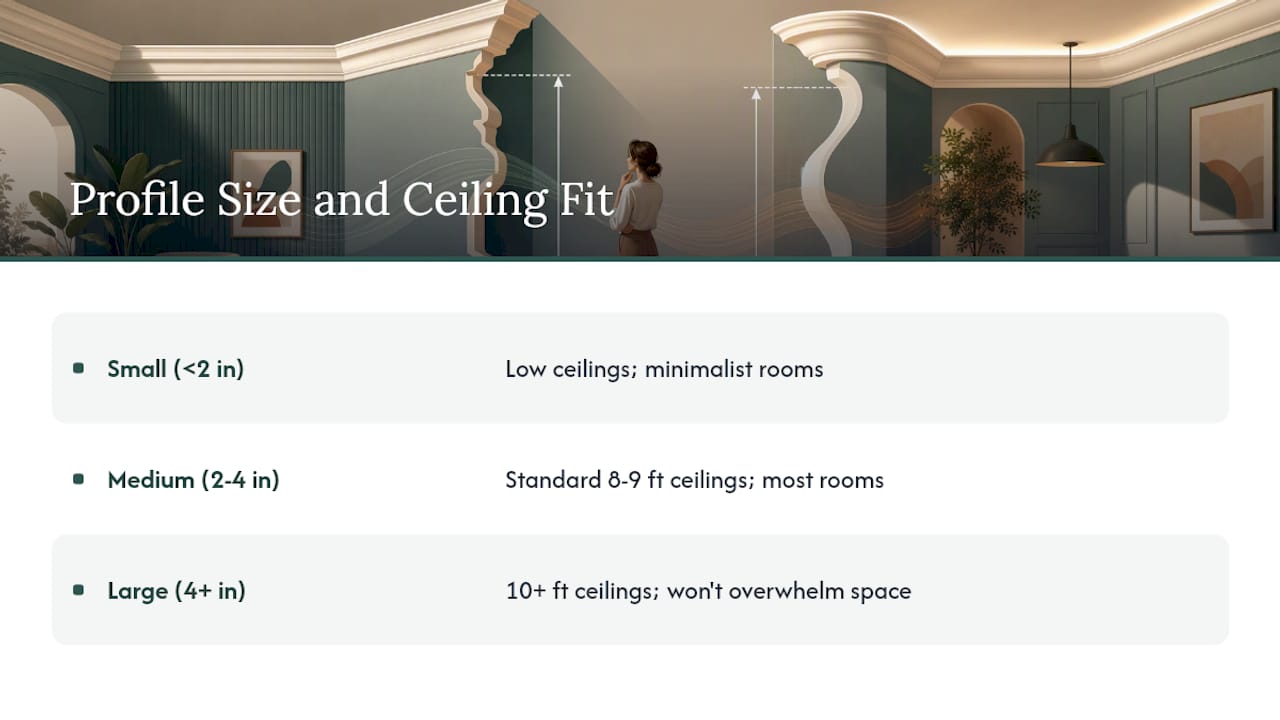
Scale matters as much as shape. As a rough guide: small profiles (under 2 inches) suit low ceilings and minimalist rooms, medium profiles (2 to 4 inches) fit most standard 8 to 9 foot ceilings, and large profiles (4 inches and up) belong in rooms with 10 foot ceilings or higher, where they won’t overwhelm the space.
Pro Tip: Stand at the doorway and look at the ceiling height relative to the wall length before picking a profile size. A 5 inch crown on an 8 foot ceiling in a small bedroom will make the walls feel like they’re closing in.
Where Each Molding Actually Gets Used
Crown earns its keep in formal living rooms, dining rooms, and any space with 9 foot ceilings or taller, especially where you’re building up a layered assembly with multiple trim pieces. It’s also the classic choice for topping kitchen cabinets in a traditional-style kitchen.

Cove shows up more often in kitchens, bathrooms, stair treads, and simple cabinet trim, anywhere a clean line matters more than ornamentation. It’s a common choice on stair stringers because its narrow profile handles angled cuts without a fight.
At the 2 to 3.5 inch range, the two options genuinely overlap. A wider cove and a narrow crown can serve the same cabinet-top or mantel job interchangeably, so don’t assume the label on the shelf tag settles the decision for you.
Materials and Sizes Worth Knowing
Solid wood species like poplar, oak, and pine give you real grain for staining, but they cost more and show every seam. MDF is the go-to for painted trim because it’s smooth, consistent, and free of the knots that telegraph through paint. Polyurethane and PVC moldings resist swelling and splitting in bathrooms and other high-moisture rooms, where wood and even MDF can eventually warp.
Typical residential widths break down roughly like this:
Small: ¾ inch to 2 inches, for tight spaces, cabinets, and stair trim
Medium: 2 to 4 inches, the workhorse range for standard rooms
Large: 4 inches and up, reserved for crown in rooms with taller ceilings
If you’re staining, go with solid wood; if you’re painting, MDF is the more forgiving and budget-friendly pick.
Cutting, Coping, and What Each Installation Actually Involves
Cove molding and smaller crown pieces cut cleanly at a standard 45 degree miter on a regular miter saw, which is why cove is often the easier starting point for a first molding project. Larger crown pieces are a different story. They usually need to be cut flat on a compound miter saw, angled to mimic how the piece sits against the wall and ceiling.
Inside corners are where technique really matters. Many carpenters cope crown molding at inside corners rather than mitering them, because a coped joint (cutting one piece to match the profile of the other) closes tight even if the corner isn’t a perfect 90 degrees. Mitered inside corners on an out-of-square wall tend to gap over time.
Measure the room and mark stud locations before cutting anything.
Cut and test-fit one corner at a time, coping inside corners and mitering outside ones.
Pre-finish or prime pieces before installation if painting, then nail, caulk seams, and fill nail holes last.
You’ll need a miter saw (compound for larger crown), a coping saw, a brad nailer, wood filler, and caulk at minimum.
Pro Tip: Dry-fit every piece around the entire room before you nail a single one in place. Cutting all four walls first and catching a bad angle early saves you from ruining an expensive length of crown halfway through the job.
How to Choose Between Crown and Cove
Run through these before you buy anything:
What’s the room’s function, formal or everyday?
How tall is the ceiling?
Are you going for ornate or minimalist?
What’s your budget per linear foot?
What’s your actual comfort level with a miter saw and coping cuts?
As a rule of thumb, ceilings under 8 feet usually do better with a small cove or no molding at all, while ceilings at 10 feet or taller can carry substantial crown without looking heavy.
Formal room, tall ceiling, decent budget → crown
Everyday room, tight budget, first-time DIYer → cove
Want texture without full commitment → stack a narrow cove under a modest crown
What Molding Actually Costs and How Long It Takes
Material costs vary by profile and finish grade, and labor time depends heavily on how many corners you’re coping. Here’s a general planning range:
Approach | Material Cost | Time Estimate |
|---|---|---|
Paint-grade MDF, DIY | Lower cost per linear foot | One weekend for a standard room |
Primed polyurethane, DIY | Mid-range cost per linear foot | One weekend, easier on curved walls |
Solid wood, DIY | Higher cost per linear foot | Weekend to several days, more coping |
Any material, professional install | Material cost plus labor | One to two days depending on complexity |
Cove generally installs faster because it skips complex coping in most rooms. Ornate crown with built-up layers or heavy coping work is where a weekend project can stretch into several days, DIY or not.
Stacking Cove and Crown for a Layered Look
Crown gets stacked with dentil molding or a secondary band for a built-up, architectural look on mantels and formal ceilings. Cove works well layered too, tucked beneath a wider crown to add an extra shadow line without going full multi-piece assembly.
Dentil plus crown: dining rooms, formal entries
Cove under crown: living rooms wanting depth without excess
Simple cove alone: bathrooms, stairs, low-ceiling rooms
Skip stacking on ceilings under 8 feet. Combined profiles eat vertical space fast and can make a small room feel boxed in.
When It’s Time to Call a Contractor
Ornate crown with dentil detail, coped inside corners on an older home, or a tight renovation timeline are all situations where a contractor earns their fee. Uneven ceilings, warped studs, and complicated stair-run angles are red flags that turn a “simple” molding job into hours of troubleshooting for a first-timer.
Multiple rooms with mismatched wall angles
Ceilings that visibly dip or slope
Stair trim requiring compound angle cuts
Pro Tip: When you request a quote, ask specifically whether the price includes coping labor or just straight miter cuts. That single question separates a rough estimate from an accurate one.
A Quick Note From the Field
I’ve seen homeowners default to crown because it looks impressive in photos, then regret it in a room where cove would have done the job with a tenth of the coping headaches. If you’d rather skip the trial and error, Spagnotti Contracting builds detailed estimates around your actual ceiling and corner conditions before a single cut gets made.
Get Molding Installed Right the First Time
Coped crown corners on out-of-square walls are exactly where DIY molding projects go sideways, and it’s the single biggest reason Omaha homeowners call in a pro rather than fight it themselves all weekend. Spagnotti Contracting handles interior carpentry and trim work with detailed upfront estimates, so you know your material and labor costs before work starts, not after a surprise change order.

You get quality workmanship on the cuts and joints that actually show, plus a project timeline that’s managed start to finish instead of squeezed between other jobs. If you’re weighing crown against cove for a living room, staircase, or kitchen upgrade in the Omaha metro area, request an estimate through Spagnotti Contracting’s services page and get a straight answer on what your specific room needs.
Frequently Asked Questions
What is the main difference between crown and cove molding? Cove has a single concave curve that sits flush against the corner, while crown uses a compound curve that projects outward for a more dimensional, formal look.
Is cove molding easier to install than crown molding? Generally yes. Cove and smaller crown pieces cut cleanly at a standard 45 degree miter, while larger crown often requires flat cutting on a compound miter saw plus coping at inside corners.
Can I use crown and cove molding together? Yes. Stacking a narrow cove beneath a wider crown adds an extra shadow line and depth without committing to a full multi-piece assembly, and it works especially well on mantels and formal ceilings.
What size crown molding works best for standard 8 foot ceilings? Stick to small or medium profiles, generally under 3 inches, since large crown molding can make an 8 foot ceiling feel lower and more cramped than it is.
Should I paint or stain my molding? Paint-grade jobs do best with MDF, which has a smooth surface and no visible knots. If you want the wood grain to show, choose solid wood and stain it.
Sources
What Is The Difference Between Cove & Crown Molding? (Hunker)
The Difference Between Crown Molding and Cove Molding | Henley Supply Millwork
Recommended
Dealing With Something Similar?
Every property is different, but if this sounds like what you’re seeing, we’re happy to take a look and help you figure out what’s actually going on.